Monday

Ravennae Inundata

mosaics circa 535 AD,  presbytery vault, San Vitale, Ravenna
“Ostrogoths” I said, punching Erling on the arm. As we entered the Basilica of San Vitale we heard music, and I froze on the spot. At first I thought it was in my head, because that’s not terribly unusual for me, but the magnificent tenor voice was coming from small well-placed speakers which filled the entire church with sound. Not plainsong or medieval chant, but a contemporary Russian choir singing a credo. Theatrical, yes, and compelling. We soon found ourselves overwhelmed by 5th century mosaics glittering with symbolism. 
Traveling with Erling is always good in these instances because like me he has a thorough education in Christian history and further, he is fascinated with it. Lunchtime conversations may involve intense discussions about transubstantiation or the Arian heresy. 

The walls of the Basilica di San Vitale are clad in book-matched marble imported from Constantinople
 
In such a place where there are so many brilliant buttons for my mind to push, my brain is flooded with words and phrases.  So passed this day...
   
geometry... fondo oro... iota... filioque... cosmatesco... horror vacui... clean-shaven Jesus... gammdia... bookmatched marble... octagons... conventional design... the Empress... archaic symbols... peacocks... palm trees... acoustics... recycled roman mosaic... roman mosaic... opus alexandrinum... opus sectile... Persian flaw... matroneum... pulvino... space ships... eunuchs... ecce homo... consubstantial... homoousios... transubstantiation... transfiguration... schism... spaceships...  Ostrogoths...

 mosaic in the apse features a youthful Jesus and an uncountable number of gold glass tiles

The floor of San Vitale was raised and repaved in the 13th century and again in 1599 with cosmateque mosaics.  The original 5th century floor is about 5 feet below and completely under water
counting the border elements under the Justinian panel (547 AD) and shoes...

This border is of  Roman design and references the Trinity. or spaceships.
The famous ceiling of the "Masoleum" of Galla Placidia (d. 450) and an obvious Persian Flaw
Mosaic ceiling of the 5th century Arian baptistry


All photos in this post by Lynne Rutter  Ravenna, 2018

Listen: Credo Universale (youtube)  New Liturgical Chant of the Russian Orthodox Church  Moscow Patriarchal Choir with Ilya Tolmachevy Natalia Haszler


Livia Alberti - fascinating report on the restoration of the mosaics of San Vitale


Sunday

Looking Forward

Palazzo Corsini, Florence photo by Lynne Rutter
I am appreciating everything, even as my eyes get used to the dark.  In my head I am still 24 years old and running through the doorway to see what's around the corner, while the more mature me fumbles with my camera to be ready for it.


Wednesday

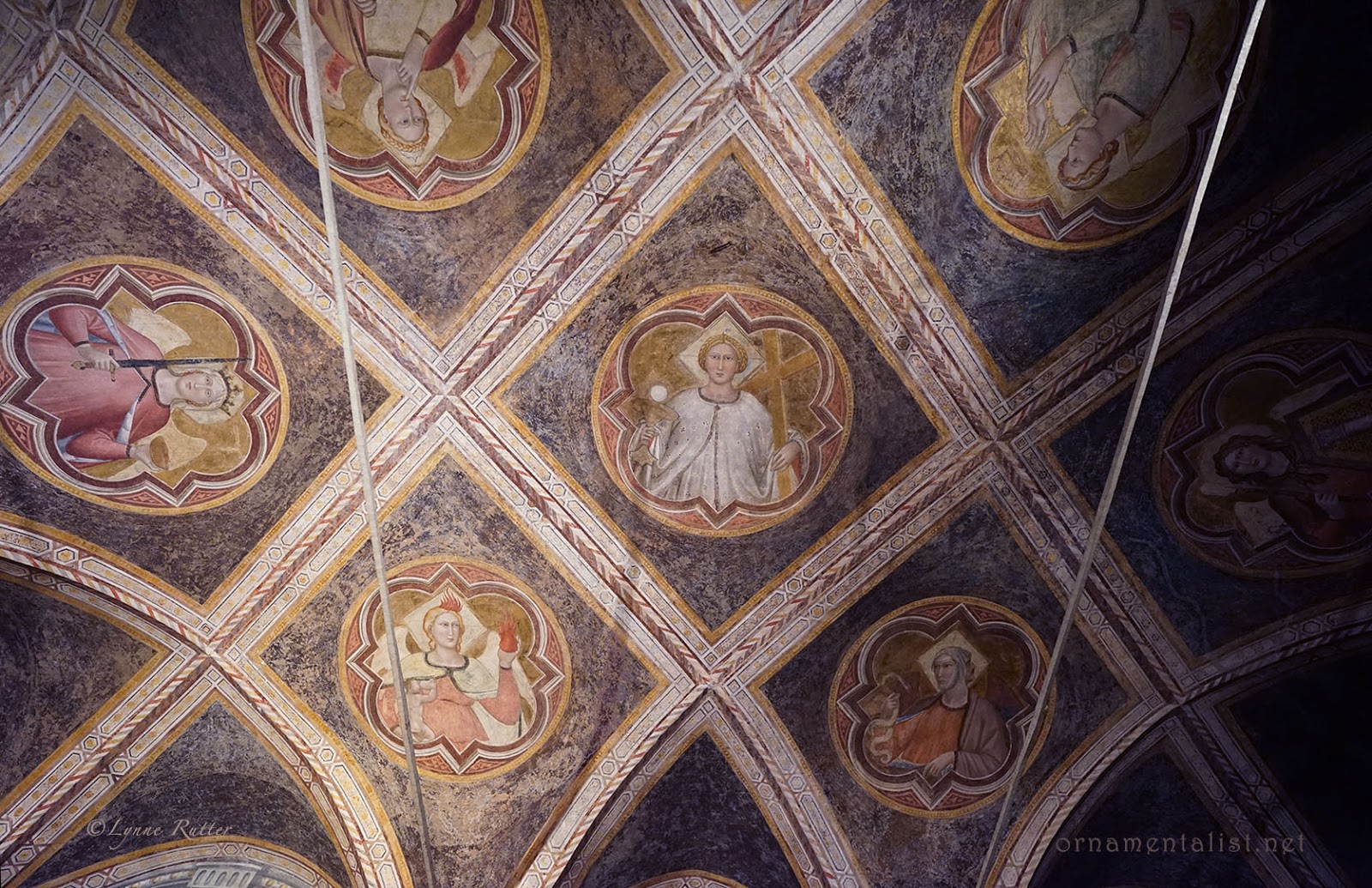
The Seven Virtues of Santa Felicità

Temperanza, fresco by Pietro Gerini 1387  Santa Felicità, Florence

The Chiesa di Santa Felicità is a small Oltrarno church whose facade holds up part of the Vasari corridor on its way to the Palazzo Pitti.  During my Florentine stay in 2014, I made repeated visits with the goal of seeing the 14th century Sala Capitolare, the Chapter Room,  in the older part of this former Benedictine convent.
I didn’t mind returning so often, and seeing my favorite Pontormo Annunciation in the Capponi Chapel, and the Poccetti murals in the chapel opposite to it.  I became friendly with the volunteer sitting inside the church who would see me coming in just about every week. She knew my name, because I’d given her my card in February, and she pronounced it Leeee-na. She wrote on a slip of paper “venerdi 13-16h” for me, meaning that between 1 and 4 PM on Fridays the Gothic sections of the building are open, and I kept this bit of paper in my wallet.
But every Friday when I returned, she would then say “oh, non oggi, non possiamo aprire la sala… puoi tornare la prossima settimana...” and then “sorry” the only English word she seemed to know. Apparently more volunteers were needed to escort people back there, and she was minding the door on her own.
The very last Friday of April, at the end of my sabbatical, I showed up one last time, and encountered a different volunteer, but the same rejection, and I was deeply embarrassed when my disappointment turned into tears. Why did I need to see this interior so badly? 

A pair of gilt reliquary busts designed for the relics of martyrs, Santa Felicità, Florence.
Earlier this year (2017) I made another visit, this time in a wheelchair having broken my ankle, and was elated to find the Sala Capitolare open, and two extra volunteers on hand to lay a plank on the stairs.  Erling took something of a running start to push me into the room, to the long-for glimpse of the Gothic painting inside. 

The chapter room of Santa Felicità, with a gothic ceiling and baroque murals
The Crucifixion mural and the ceiling of the Seven Virtues were painted in 1387 by Niccolò di Pietro Gerini, a follower of Giotto. Only traces of blue remain, and this is because blue pigments like lapis lazuli are generally unstable in wet plaster, and so are added over a red or brown base a secco, after the fresco is dry.  These tend to be the first to be lost, leaving the reddish color underneath, and as a result these paintings have an overall warm brown look. (In this case the color is further muddied by the fluorescent lights used in this room.)  The fields on this ceiling also show the ghosts of Giotto-style 8-pointed gilt stars.

A Favorite Detail:  The ribbed groin-vault of this ceiling is a painted effect.  What is actually a rather shallow barrel vault was given the appearance of ribbing by the addition of painted geometric boarders dividing the space into sections. A striped border changes direction, and a painted shadow along one side adds relief, making the ceiling feel taller, more graceful, and more substantial.  Other borders have faux-mosaic "cosmatesque" designs which enhance the illusion and act as frames for the panels.

cosmatesque borders flank the "ribs" of the trompe l'oeil groin vault, Santa Felicità, Florence


The allegorical figures of the Virtues, have square or octagonal halos.  This is, I have learned, a convention to distinguish them from angels or saints. Like saints, the figures are depicted with their attributes:  Fides (faith) holds a chalice with the host;  Charitas (charity) nurses a baby and holds a flame in her hand; Iustitia (justice) wields a sword and scales; Prudenza (prudence) is often depicted with a face on the back of her head and holding a snake; Spes (hope) holds up her hands in payer; Fortitudo (fortitude) carries a shield with a pillar.  Temperanza (temperance) (see first image above) puts a finger to her lips in silence and self-restraint.

The Seven Virtues, ceiling fresco painted by Pietro Gerini 1387,  Santa Felicità, Florence
Murals by Cosimo Ulivelli and Angelo Gori, 1665    Santa Felicità, Florence
The Chapter room and its pronaos (porch) had been open to the cloister on one side, and there had been a lot of moisture damage, but in 1615 this area was enclosed. Then in 1665, the artists Cosimo Ulivelli and Agnolo Gori frescoed the walls with murals and quadratura architecture. 
It's possible the older areas were painted over when the room was remodeled, but despite being aesthetically at odds with the ceiling,  the murals do seem to have been designed to work with it.

Santa Felicità was ordered to close on 11 October 1810, when Napoleon suppressed the monasteries of Florence. The murals were then completely whitewashed over, and have only recently been restored.


Let's review:   
Visits- lost count
Years - three
Cosmatesque ornament- check
Tears- twice (once inside the room) 
Virtues - seven.  No, eight - patience is also a virtue!


Santa Felicità has a new! website with some nice virtual visit links.


All photos in this post by Lynne Rutter, Florence, 2017.  click on images to view larger.


Friday

Winter Garden


The Winter Garden room an a dark winter day. photo by Lynne Rutter
Winter Solstice, on the darkest afternoon in Florence, I visited some rooms of the Casa Martelli, the refined home of a once wealthy and important Florentine dynasty.  Now a state museum, the former palace can be visited with volunteer guides, carefully avoiding areas in desperate need of restoration.  The house contains wonderful art collection in situ and many decorated rooms spanning several centuries.

The Winter Garden as they call is, is an entire room frescoed with trellises and vines under a warm sunny sky, with birds and fountains and other formal garden follies. A pair of gas lanterns indicate it was once used as a  billiard room.

trompe l'oeil topiary architecture in the frecoed Winter Garden at Casa Martelli  photo by Lynne Rutter

photo by Massimo Listri, 2009

I am not sure if I would ever have heard of the Casa Martelli had I not already been stalking following the work of the brilliant  Florentine photographer Massimo Listri, whose evocative images include a shot of the Winter Garden in its abandoned state years ago.


More from Florence soon!

Sunday

Églomisé Rhinoceros


Allow me to introduce you to "Albert," a name that means  both "bright" and "famous."

"Albert" a six foot-wide verre églomisé rhinoceros in rose gold, by Lynne Rutter. photo by David Papas.

Approximately two meters wide, Albert is a verre églomisé mural,  etched into gold on the reverse side of glass, and based on ( and named for)  the famous rhinoceros woodblock print by Albrecht Dürer. 
This commission came about  when my client asked for a large painting with gold or copper and maybe an animal, or an imaginary creature, and then I said well you know if I did this on the back of glass, it would be way more work and so much more expensive but so totally cool!   So of course they said yes.

the enlarged master drawing in reverse
We chose the image of the rhinceros, which Dürer created having seen only a sketch of an Indian rhino.  The folds of the skin look very much like armor.  Dürer added an extra little spiral horn on the spine of his noble beast, as well as a pattern of spots over the "armor."
My first step in creating this mural was to get to know this creature very well, through a series of drawings at large size, in reverse, as this is how I needed to etch the image.

As red gold, coincidentally known as "Albertina Gold," was being used for this piece, it was essential to work on Starfire glass, which is clear and colorless, as the color of normal glass would muddy the special rosy tone of the gold leaf.

The rhino gilt with rose gold leaf on clear glass
I gilt the rhino's body with a mirror finish,  and then began etching the design through the gold. 

etching the 23 karat rose gold
Once the body of the rhino was complete, the background was gilded with the same red-gold leaf, but with a matte finishin in a broken leaf pattern.  Additional features were then etched into it. The piece was backed with a chocolate brown paint, and then mounted in a float frame of solid walnut built by Christine Lando. 

Photographer David Papas takes Albert's fashion portrait in the studio
To photograph a mirror is pretty difficult!   My photographer David Papas created a white environment to reduce reflections in order to document this piece (see  his amazing shot in the first image above.)

Albert the églomisé rhino reflects on his new surroundings
Installed in his new home Albert is the boss of the entire first floor. At first a ghostly apparition, the details of his face and body are visible from certain angles as you- and he- move about the room.  

I love that moment when the gold locks onto the glass...


Thanks to:  
Michelina and Adrian!
David Papas Photographer
Christine Lando, artist, archival framer
Farber Art Services  expert installation
W&B Gold Leaf