Showing posts with label murals. Show all posts

Friday

Underground Treasure in Venice

In which we discover Venetian Pearls and Buried Beauty 


San Simeone Piccolo, Venice, built 1738
The Maestro, as we call him, composed the first two acts of his new opera in the spare bedroom of our Florentine flat this winter. When the time came for him to take this work up to Austria to present it to the theatre, we put the electric piano in a snowboard bag (it fit perfectly) to make it easier to take on the train.
I know, it sounds glamorous, and maybe it is.

A glass bead coral necklace by Marisa Convento

I accompanied Erling and his piano as far as Venice, and treated myself a day to wander about the city on an unusually warm and uncrowded midwinter day, feeling a bit blue that I would not be staying for Carnivale this time. Feeling even bluer that I wasn't able to return to Venice with my mother, something we talked about a lot during her last year.  I was cheered and inspired by a visit with the great Impiraressa, Marisa Convento, a Venetian artisan reviving the traditional art of seed glass beading from her small shop in San Marco, Venetian Dreams.  Not just an expert beader, Mariso knows the history of her art, and the significance of its revival.  She works with vintage and antique glass beads, and has an impressive collection of the special "Pearls:" antique (and highly collectible) Murano-made beads used for centuries in trading around the world, and which have found their way back to the city, and into her skilled hands.
Marisa is one of the artisans involved with Venezia Autentica, a brilliant organization helping to educate visitors on how to have a more meaningful experience in a city being trampled by mass tourism.  While we commiserated on the fate of the artists in our respective cities, I could see that the fight to save Venice may well be won by her artists.  Who knows more about perseverance than a Venetian?  Than a Venetian artist? 

Buried Treasure
Just across the canal from Santa Lucia station is the strangely proportioned church of San Simeone Piccolo (above.)   Attracted by its impressive copper green dome, visitors might peek inside the circular nave, see the protective plastic sheet covering the ceiling, and then leave.  I personally have never seen the inside of this dome and the church under it is unremarkable. However, this church keeps a secret treasure in its crypt.  You can buy a candle from the attendant as admission, and go down the stairs.

Now, stay still, until your eyes get used to the dark. 

painted designs on the walls of the crypt
You will see, the entire crypt is covered in ornament and murals! Rough and sort of theatrical in style, the painting shows up pretty well in low light.  Most of the ornament is done with a very limited palette of yellow ochre,  red, white, and a bit of black.

Lit by a single candle, the crypt walls and ceiling are visible only for a few feet.
Crypt ceiling painted in ornament with red and yellow ochre
Yes it is well below ground, and yes it is damp and cold.  It appears to have been painted in the 18th century after the church was built,  and I have no idea if...  
darn it my candle went out and I have to make my way back to the entrance, where one little candle was left burning.    
Xe mejo on mocolo impissà che na candela stuà. (1)

A small chapel in the center of crypt, lit by a single light near the entrance
Radiating from a central octagonal chapel are corridors leading to small shrines and burial chambers, These were ransacked and ill-used during the Napoleonic period. Any records about who is buried here were lost at that time.  Any candelabra that may have been here... have not been replaced.

A mournful mural detail by candlelight
A small shrine inside the crypt with loose but effective trompe l'oeil painting
The stoning of St Stephen,  in a faux gold mosaic cartouche.*
I don't have a flash on my camera but I resort to using the flashlight of my phone a few times. 
Especially when I hear things.

Entrance to a family tomb
inside a tomb, with a yellow, black, and ochre color scheme
A tomb where the tunnels split into four directions. The trompe l'oeil grill on the ceiling mimics a real grill elsewhere in the crypt.
macabre decoration in the crypt of San Simeone Piccolo, lit by a single candle


Five months later, in Klagenfurt rehearsals have started.  In three hours I  am in Venice to see the spectacular retrospective of Nancy Genn at the Palazzo Fero-Fini, which corresponds with the opening the Biennale Architettura.   The art galleries are opening new shows, and prosecco is being poured in every doorway of the Dorsoduro.

Erling joins me for one day. I pay my respects to Tintoretto.  On our way back, I stay with the bags while Erling ventures into the crypt.


It is perhaps better if you go into the crypt alone.


(1) Venetian proverb: Better to have a lit candle stub than an extinguished candle. 

All photos in this post by Lynne Rutter, 2018
except* by Erling Wold

Rattensturm a opera by Erling Wold and Peter Wagner,  13 -30 June, 2018 at the Klagenfurter Ensemble, Klagenfurt-am-Worthersee, Austria.

Churches of Venice  website in English with details on every church and its art

Venetian Dreams  Marissa Convento on Instagram
Alessia Fuga  contemporary glass bead artist

Venezia Autentica   because the more you know about Venice the more you will love it


Wednesday

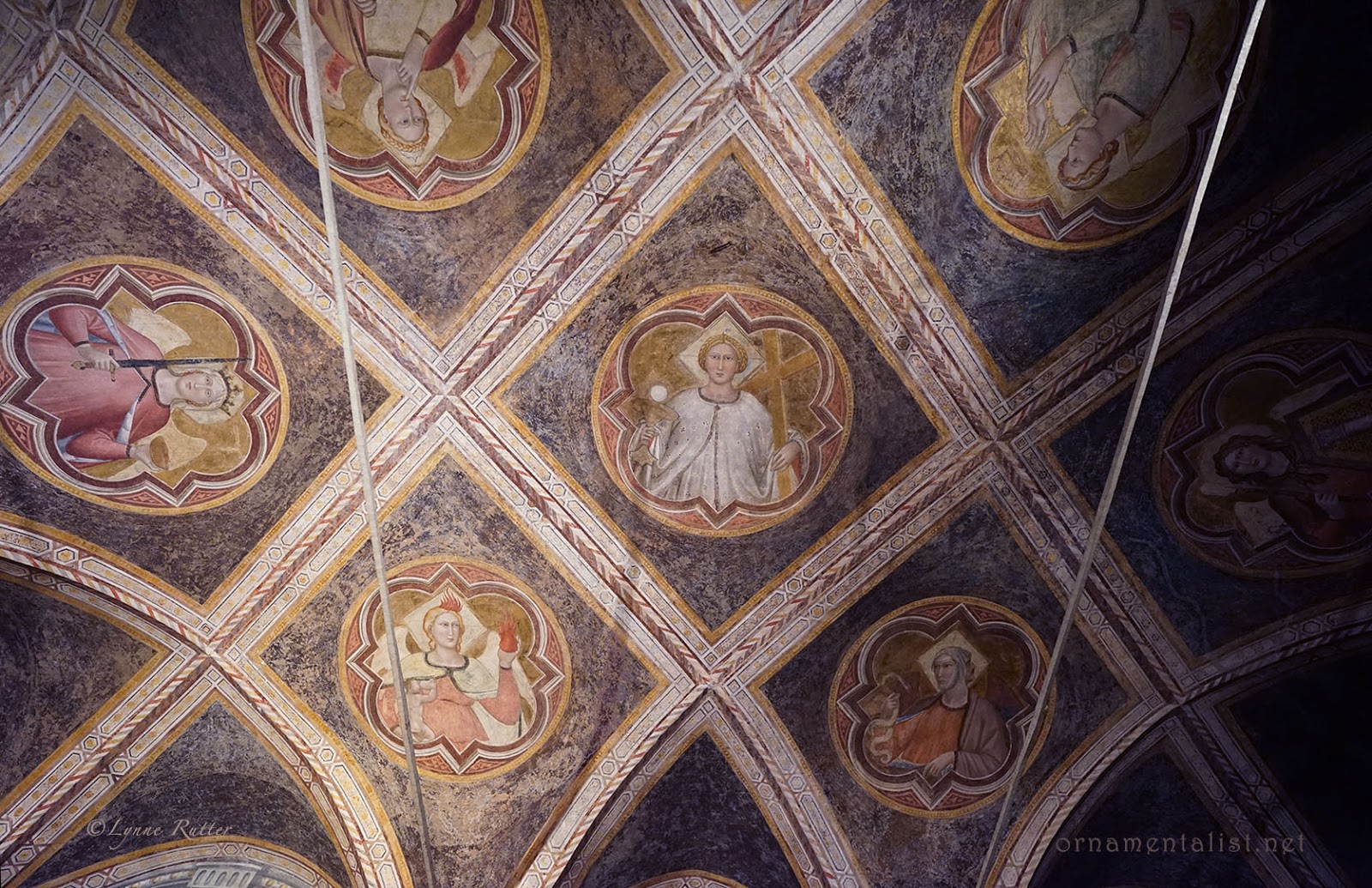
The Seven Virtues of Santa Felicità

Temperanza, fresco by Pietro Gerini 1387  Santa Felicità, Florence

The Chiesa di Santa Felicità is a small Oltrarno church whose facade holds up part of the Vasari corridor on its way to the Palazzo Pitti.  During my Florentine stay in 2014, I made repeated visits with the goal of seeing the 14th century Sala Capitolare, the Chapter Room,  in the older part of this former Benedictine convent.
I didn’t mind returning so often, and seeing my favorite Pontormo Annunciation in the Capponi Chapel, and the Poccetti murals in the chapel opposite to it.  I became friendly with the volunteer sitting inside the church who would see me coming in just about every week. She knew my name, because I’d given her my card in February, and she pronounced it Leeee-na. She wrote on a slip of paper “venerdi 13-16h” for me, meaning that between 1 and 4 PM on Fridays the Gothic sections of the building are open, and I kept this bit of paper in my wallet.
But every Friday when I returned, she would then say “oh, non oggi, non possiamo aprire la sala… puoi tornare la prossima settimana...” and then “sorry” the only English word she seemed to know. Apparently more volunteers were needed to escort people back there, and she was minding the door on her own.
The very last Friday of April, at the end of my sabbatical, I showed up one last time, and encountered a different volunteer, but the same rejection, and I was deeply embarrassed when my disappointment turned into tears. Why did I need to see this interior so badly? 

A pair of gilt reliquary busts designed for the relics of martyrs, Santa Felicità, Florence.
Earlier this year (2017) I made another visit, this time in a wheelchair having broken my ankle, and was elated to find the Sala Capitolare open, and two extra volunteers on hand to lay a plank on the stairs.  Erling took something of a running start to push me into the room, to the long-for glimpse of the Gothic painting inside. 

The chapter room of Santa Felicità, with a gothic ceiling and baroque murals
The Crucifixion mural and the ceiling of the Seven Virtues were painted in 1387 by Niccolò di Pietro Gerini, a follower of Giotto. Only traces of blue remain, and this is because blue pigments like lapis lazuli are generally unstable in wet plaster, and so are added over a red or brown base a secco, after the fresco is dry.  These tend to be the first to be lost, leaving the reddish color underneath, and as a result these paintings have an overall warm brown look. (In this case the color is further muddied by the fluorescent lights used in this room.)  The fields on this ceiling also show the ghosts of Giotto-style 8-pointed gilt stars.

A Favorite Detail:  The ribbed groin-vault of this ceiling is a painted effect.  What is actually a rather shallow barrel vault was given the appearance of ribbing by the addition of painted geometric boarders dividing the space into sections. A striped border changes direction, and a painted shadow along one side adds relief, making the ceiling feel taller, more graceful, and more substantial.  Other borders have faux-mosaic "cosmatesque" designs which enhance the illusion and act as frames for the panels.

cosmatesque borders flank the "ribs" of the trompe l'oeil groin vault, Santa Felicità, Florence


The allegorical figures of the Virtues, have square or octagonal halos.  This is, I have learned, a convention to distinguish them from angels or saints. Like saints, the figures are depicted with their attributes:  Fides (faith) holds a chalice with the host;  Charitas (charity) nurses a baby and holds a flame in her hand; Iustitia (justice) wields a sword and scales; Prudenza (prudence) is often depicted with a face on the back of her head and holding a snake; Spes (hope) holds up her hands in payer; Fortitudo (fortitude) carries a shield with a pillar.  Temperanza (temperance) (see first image above) puts a finger to her lips in silence and self-restraint.

The Seven Virtues, ceiling fresco painted by Pietro Gerini 1387,  Santa Felicità, Florence
Murals by Cosimo Ulivelli and Angelo Gori, 1665    Santa Felicità, Florence
The Chapter room and its pronaos (porch) had been open to the cloister on one side, and there had been a lot of moisture damage, but in 1615 this area was enclosed. Then in 1665, the artists Cosimo Ulivelli and Agnolo Gori frescoed the walls with murals and quadratura architecture. 
It's possible the older areas were painted over when the room was remodeled, but despite being aesthetically at odds with the ceiling,  the murals do seem to have been designed to work with it.

Santa Felicità was ordered to close on 11 October 1810, when Napoleon suppressed the monasteries of Florence. The murals were then completely whitewashed over, and have only recently been restored.


Let's review:   
Visits- lost count
Years - three
Cosmatesque ornament- check
Tears- twice (once inside the room) 
Virtues - seven.  No, eight - patience is also a virtue!


Santa Felicità has a new! website with some nice virtual visit links.


All photos in this post by Lynne Rutter, Florence, 2017.  click on images to view larger.


Friday

Winter Garden


The Winter Garden room an a dark winter day. photo by Lynne Rutter
Winter Solstice, on the darkest afternoon in Florence, I visited some rooms of the Casa Martelli, the refined home of a once wealthy and important Florentine dynasty.  Now a state museum, the former palace can be visited with volunteer guides, carefully avoiding areas in desperate need of restoration.  The house contains wonderful art collection in situ and many decorated rooms spanning several centuries.

The Winter Garden as they call is, is an entire room frescoed with trellises and vines under a warm sunny sky, with birds and fountains and other formal garden follies. A pair of gas lanterns indicate it was once used as a  billiard room.

trompe l'oeil topiary architecture in the frecoed Winter Garden at Casa Martelli  photo by Lynne Rutter

photo by Massimo Listri, 2009

I am not sure if I would ever have heard of the Casa Martelli had I not already been stalking following the work of the brilliant  Florentine photographer Massimo Listri, whose evocative images include a shot of the Winter Garden in its abandoned state years ago.


More from Florence soon!

Sunday

Églomisé Rhinoceros


Allow me to introduce you to "Albert," a name that means  both "bright" and "famous."

"Albert" a six foot-wide verre églomisé rhinoceros in rose gold, by Lynne Rutter. photo by David Papas.

Approximately two meters wide, Albert is a verre églomisé mural,  etched into gold on the reverse side of glass, and based on ( and named for)  the famous rhinoceros woodblock print by Albrecht Dürer. 
This commission came about  when my client asked for a large painting with gold or copper and maybe an animal, or an imaginary creature, and then I said well you know if I did this on the back of glass, it would be way more work and so much more expensive but so totally cool!   So of course they said yes.

the enlarged master drawing in reverse
We chose the image of the rhinceros, which Dürer created having seen only a sketch of an Indian rhino.  The folds of the skin look very much like armor.  Dürer added an extra little spiral horn on the spine of his noble beast, as well as a pattern of spots over the "armor."
My first step in creating this mural was to get to know this creature very well, through a series of drawings at large size, in reverse, as this is how I needed to etch the image.

As red gold, coincidentally known as "Albertina Gold," was being used for this piece, it was essential to work on Starfire glass, which is clear and colorless, as the color of normal glass would muddy the special rosy tone of the gold leaf.

The rhino gilt with rose gold leaf on clear glass
I gilt the rhino's body with a mirror finish,  and then began etching the design through the gold. 

etching the 23 karat rose gold
Once the body of the rhino was complete, the background was gilded with the same red-gold leaf, but with a matte finishin in a broken leaf pattern.  Additional features were then etched into it. The piece was backed with a chocolate brown paint, and then mounted in a float frame of solid walnut built by Christine Lando. 

Photographer David Papas takes Albert's fashion portrait in the studio
To photograph a mirror is pretty difficult!   My photographer David Papas created a white environment to reduce reflections in order to document this piece (see  his amazing shot in the first image above.)

Albert the églomisé rhino reflects on his new surroundings
Installed in his new home Albert is the boss of the entire first floor. At first a ghostly apparition, the details of his face and body are visible from certain angles as you- and he- move about the room.  

I love that moment when the gold locks onto the glass...


Thanks to:  
Michelina and Adrian!
David Papas Photographer
Christine Lando, artist, archival framer
Farber Art Services  expert installation
W&B Gold Leaf


The Dream of Constantine- a modern perspective

"The Dream of Constantine" by Piero della Francesca, circa 1464 (photo: Lynne Rutter)
We made a short trip to Arezzo, pretty much just to see Piero della Francesca's masterpiece "The Legend of the True Cross" in the Basilica di San Francesco. 
This is a really staggering work telling the somewhat convoluted story of the cross and the revered wood from which it was made.  It is the only surviving grand fresco cycle by Pierro della Francesca.

For most of his career della Francesca pursued mathematics as well as painting, and was for a long time after his death remembered more as a mathematician than as an artist, having written (and illustrated) texts on perspective, geometry, and techniques for creating perspective with color. 

I kept going back to this one panel, depicting a sleeping Constantine in a perfectly centered gold tent with a cone-shaped rose-colored top, against a blue and realistically starry night sky (purportedly the first ever depicted in Western Art.) Two guards and a terribly bored servant are oblivious to the bright light emanating from the delicate cross held by a dramatically backlit angel. The soldiers are thrown into deep shadow, emphasizing the unearthly light source.

I cannot help but think how modern this painting feels, with its strong blocks of color and an abstraction that seems more 20th than 15th century.


Get obsessed with me:
~ De prospectiva pingendi  illustrated treatise on perspective by Pierro della Francesca- facsimile at the Galileo Museum, Florence.
~ In the footsteps of Piero della Francesca - follow his work through Tuscany with a special phone app.
~An interesting paper on the night sky of this painting, and the star map on which it may have been based.

Thursday

Studio Visit: Jennifer Carrasco

Ship of Fools:   Chinosierie mural detail by Jennifer Carrasco*

So a couple of years ago, I get this email from my friend Jennifer Carrasco asking about canvas for a big job... I love talking shop with my fellow muralists and I was happy to dump all sorts of advice on her whether needed or not.  For the next year or so there was a lot of back and forth about the technical and physical challenges of this huge commission of Chinoiserie, which Jennifer designed in a highly personal style including many details that resonated with her client's personality and philosophy.  The 20 foot high mural panels were painted for a fabulous home on Vashon Island, creating a truly over-the-top fantasy rivaling anything you can find in Brighton or Drottningholm. 

Jennifer Carrasco in the fantastic Chinoiserie mural she created for her client on Vashon Island*

As I am a huge fan of Jennifer and her work I was very excited to get a chance to visit her Seattle garden studio after Salon 2014 was held in Seattle last May,  just after this stupendous mural had been installed.

Jennifer in her studio, scale drawing of her Chinosierie mural
Surrounded by her garden,  Jennifer's studio is a charming and compact creative space cleverly outfitted to her needs thanks in large part to the carpentry genius of her partner, Phil.

Large projects require enormous amounts of organization and planning, especially when being produced in smaller spaces.  The entire chinoiserie project was designed and laid out in a scale drawing overlaid with a carefully numbered grid, the staggered panels were measured and cut in a large sail loft, and then sent to a commercial paint shop to be spray painted with the gradated colors of the background, then the grid transferred to the canvas.

Phil designed an ingenious system to allow Jennifer to paint these 20+ foot high mural panels in this studio, by devising  two stations with "drafting table" style painting areas and  pairs of rollers to dispense and roll up the canvas.  This way Jennifer can paint seated at a large, angled table rather than standing on ladders, or sitting on the floor or any of the other difficult postures we  have to assume when doing large pieces   Jennifer bragged to me early on that this set up "has added years to my mural painting life."

Inside and outside, Jennifer Carrasco's garden studio in Seattle
This clever mural painting set-up allows for comfortable ergonomic painting while seated.*
behind the mural painting wall is beautifully organized storage 


I really loved the storage opportunity that was built into the back of the painting wall.  I'm afraid I am the type to get rather too excited about such things.

In addition to this charming style of Jenoiserie, as she calls it, Jennifer is well known for illustration work and for painting  fearlessly colorful murals and environments such as the famous ballroom of the Seattle restaurant The Ruins.   Her work is infused with humor, nature and pure joy.    You can see more of her paintings at her beautiful website.

 
Selected Jenoiserie is also available now via Spoonflower in fabric, wallpaper and other printed items!!

Chinoiserie peonies by Jennifer Carrasco*

color samples and sketches at Jennifer Carrasco's studio


Photos in this post by Lynne Rutter
and *courtesy Jennifer Carrasco


International Decorative Painters Salon


Tuesday

The Private Bathchamber of the Grand Duchess

a clever detail in the Grottesche ornamentation of the bath at "La Ferdinanda"

Corner of the bathchamber

Last March we ventured outside of Florence to visit the   splendid Medici Villa of Artimino known as "La Ferdinanda."   The villa was built for the Medici Duke Ferdinand I (1549-1609) as a hunting lodge and summer residence.  A World Heritage site, the estate currently hosts private events and features a winery and a hotel.

Having called ahead to explain our project and ask permission to photograph, we were warmly greeted and allowed to explore the villa and its decoration, much of which was done by the artist Domenico Passignano as well as Bernardino Poccetti.

Hidden away in a corner of the first floor,  is the “Stanzino del Poggiale” a small bathroom also called the "Ricetto del Poggiolo"  which was created for Grand Duchess Christina of Lorraine, the wife of Ferdinand I. It is completely encrusted with painted grottesca, oval landscape insets, and wild, colorful faux marble painted by Poccetti.  Closed up for hundreds of years, the room is preserved in spectacular condition.

Alison and I could hardly contain our excitement. I fumbled about with my camera.  Erling, who has long maintained that I should have my own TV show,  took a spontaneous 2 minute video with his iPhone. Which I have posted here for you.  Because you understand, don't you?


It was very difficult to photograph this tiny space (especially while hyperventilating.) Once I got a hold of myself,  I removed the giant halogen torchère from the room and inspected the charming details of the decor using only natural light, so that the true colors could best be seen. I marveled at the color palette, which alternated warm earth colors with  a cool purple and sea green.  This led to a discussion of the color of that purple, and the pigment that may have been used to make it. Is is caput mortuum?  Well not that actual "mummy brown" pigment but the hematite that makes that cardinal-robe purple.  What about that green? Malachite, of course. Sigh.


Window bay in the bath chamber- the purple borders have completely faded away

Not your usual Tuscan color scheme-- purple and seafoam green make for a cool and serene effect

Cupid and other putti on the ceiling, a later addition painted by Domenico Passignano

Passignano designed the ceiling areas with trompe l'oeil balusters and bits of sky peeking through.  Though faded, the effect is still quite convincing.   
More details:

a trompe l'oeil gold medallion with a bathing scene

lovely perspective detail with hints of gold
tiny grottesca panel over the doorway


I hope to be posting more from this beautiful villa soon.


Visit:  Villa Medicea di Artimino
photos by Lynne Rutter
video by Erling Wold
thanks always to Alison Woolley


Pascal Amblard- summer painting classes in San Francisco

It is with great excitement that I can announce that I have the honor of hosting my friend the master muralist Pascal Amblard, for a special painting workshop at Lynne Rutter Studio in San Francisco.

Tiepolo-inspired painting by Pascal Amblard
You've read more about Pascal Amblard's work here before, and hopefully bought his amazing book, Painted Homes, which explores the wide variety of his elegant work as a muralist and decorator.

A sought-after mural artist working internationally from his studio in la Haute-Savoie,  Pascal is also well known as a generous and skilled teacher.  I am thrilled to host him in my own mural studio this summer for what we have been calling the "dream class!"

October 1-6 2018      Six day Mural Master Class
This course will give those wishing to improve their mural painting skills, an opportunity to work at a grand scale,  learn mural design, drafting, and painting techniques for creating large scale works.

A preview of the type of composition we will create together ; the architecture and landscapes are borrowed from Tiepolo's frescoes in Palazzo Labbia, and the figures from his son, Giandomenico. We will use similar elements and come up with our own murals.
Pascal says:"After more than 25 years in this business I am finally organizing a "start from scratch" class.
Pascal Amblard with his demonstration mural
It is certainly the most valuable learning situation for students, and the most difficult for a teacher. Instead of starting to play a well mapped out part,  I will start improvising with you!   I know in which key we will play and what note to use or to avoid but I will be open to your ideas and suggestions. I will show you how I myself compose, mixing current and centuries-old techniques.

We will share and experience together in what is so rarely taught: how do we get from a blank piece of wall to a spectacular, harmonious and desirable mural composition.

"I will teach you the techniques I have used and refined through hundreds of murals.  As we have a lot of working space, we will do this on a grand scale.  Each person will have room to work comfortably."

This class emphasizes design and individual style as well as efficient painting techniques.

Reservation information for Mural Maser Class  here:  Mural Master Class


 Here is a rare opportunity to learn and practice in a large, light-filled, working mural studio, with one of the true masters of this art.


As of August 12, 2018  -- We have one space available.  Contact me for information about joining this masterclass


Thursday

Hidden in the Details... a Family Portrait


Capella Filippo Strozzi ceiling,  painted by Filippino Lippi
The Capella di Filippo Strozzi is one of the major chapels in Santa Maria Novella in Florence.  It was painted between 1489-1502 by Filippino Lippi, the natural son of the eminent painter ( and reputed playboy) Fra' Filippo Lippi and the beautiful Lucrezia Buti.
Initially I stopped to admire this chapel not just for its famous frescoes, but also for the inventive ornamental borders, which  cleverly incorporate the three crescent moons on the Strozzi coat of arms.
Adam, ceiling detail of the F. Strozzi Chapel.
Looking more closely at the ceiling, as I am wont to do, I noticed the face of Adam bears a striking resemblance to  Fillipino Lippi's own self-portrait.   Adam is depicted holding a wriggling child and casting a vanquished gaze at the serpent, who has the head of a lovely woman with flowing hair, and is offering a golden fig.    Is this a statement about Fillipino's father, or on the weakness of men in general?  A family portrait hidden in the details?


photos by Lynne Rutter,  February 2014
click on images to view larger