Showing posts with label symbolism. Show all posts

Monday

Ravennae Inundata

mosaics circa 535 AD,  presbytery vault, San Vitale, Ravenna
“Ostrogoths” I said, punching Erling on the arm. As we entered the Basilica of San Vitale we heard music, and I froze on the spot. At first I thought it was in my head, because that’s not terribly unusual for me, but the magnificent tenor voice was coming from small well-placed speakers which filled the entire church with sound. Not plainsong or medieval chant, but a contemporary Russian choir singing a credo. Theatrical, yes, and compelling. We soon found ourselves overwhelmed by 5th century mosaics glittering with symbolism. 
Traveling with Erling is always good in these instances because like me he has a thorough education in Christian history and further, he is fascinated with it. Lunchtime conversations may involve intense discussions about transubstantiation or the Arian heresy. 

The walls of the Basilica di San Vitale are clad in book-matched marble imported from Constantinople
 
In such a place where there are so many brilliant buttons for my mind to push, my brain is flooded with words and phrases.  So passed this day...
   
geometry... fondo oro... iota... filioque... cosmatesco... horror vacui... clean-shaven Jesus... gammdia... bookmatched marble... octagons... conventional design... the Empress... archaic symbols... peacocks... palm trees... acoustics... recycled roman mosaic... roman mosaic... opus alexandrinum... opus sectile... Persian flaw... matroneum... pulvino... space ships... eunuchs... ecce homo... consubstantial... homoousios... transubstantiation... transfiguration... schism... spaceships...  Ostrogoths...

 mosaic in the apse features a youthful Jesus and an uncountable number of gold glass tiles

The floor of San Vitale was raised and repaved in the 13th century and again in 1599 with cosmateque mosaics.  The original 5th century floor is about 5 feet below and completely under water
counting the border elements under the Justinian panel (547 AD) and shoes...

This border is of  Roman design and references the Trinity. or spaceships.
The famous ceiling of the "Masoleum" of Galla Placidia (d. 450) and an obvious Persian Flaw
Mosaic ceiling of the 5th century Arian baptistry


All photos in this post by Lynne Rutter  Ravenna, 2018

Listen: Credo Universale (youtube)  New Liturgical Chant of the Russian Orthodox Church  Moscow Patriarchal Choir with Ilya Tolmachevy Natalia Haszler


Livia Alberti - fascinating report on the restoration of the mosaics of San Vitale


Wednesday

The Seven Virtues of Santa Felicità

Temperanza, fresco by Pietro Gerini 1387  Santa Felicità, Florence

The Chiesa di Santa Felicità is a small Oltrarno church whose facade holds up part of the Vasari corridor on its way to the Palazzo Pitti.  During my Florentine stay in 2014, I made repeated visits with the goal of seeing the 14th century Sala Capitolare, the Chapter Room,  in the older part of this former Benedictine convent.
I didn’t mind returning so often, and seeing my favorite Pontormo Annunciation in the Capponi Chapel, and the Poccetti murals in the chapel opposite to it.  I became friendly with the volunteer sitting inside the church who would see me coming in just about every week. She knew my name, because I’d given her my card in February, and she pronounced it Leeee-na. She wrote on a slip of paper “venerdi 13-16h” for me, meaning that between 1 and 4 PM on Fridays the Gothic sections of the building are open, and I kept this bit of paper in my wallet.
But every Friday when I returned, she would then say “oh, non oggi, non possiamo aprire la sala… puoi tornare la prossima settimana...” and then “sorry” the only English word she seemed to know. Apparently more volunteers were needed to escort people back there, and she was minding the door on her own.
The very last Friday of April, at the end of my sabbatical, I showed up one last time, and encountered a different volunteer, but the same rejection, and I was deeply embarrassed when my disappointment turned into tears. Why did I need to see this interior so badly? 

A pair of gilt reliquary busts designed for the relics of martyrs, Santa Felicità, Florence.
Earlier this year (2017) I made another visit, this time in a wheelchair having broken my ankle, and was elated to find the Sala Capitolare open, and two extra volunteers on hand to lay a plank on the stairs.  Erling took something of a running start to push me into the room, to the long-for glimpse of the Gothic painting inside. 

The chapter room of Santa Felicità, with a gothic ceiling and baroque murals
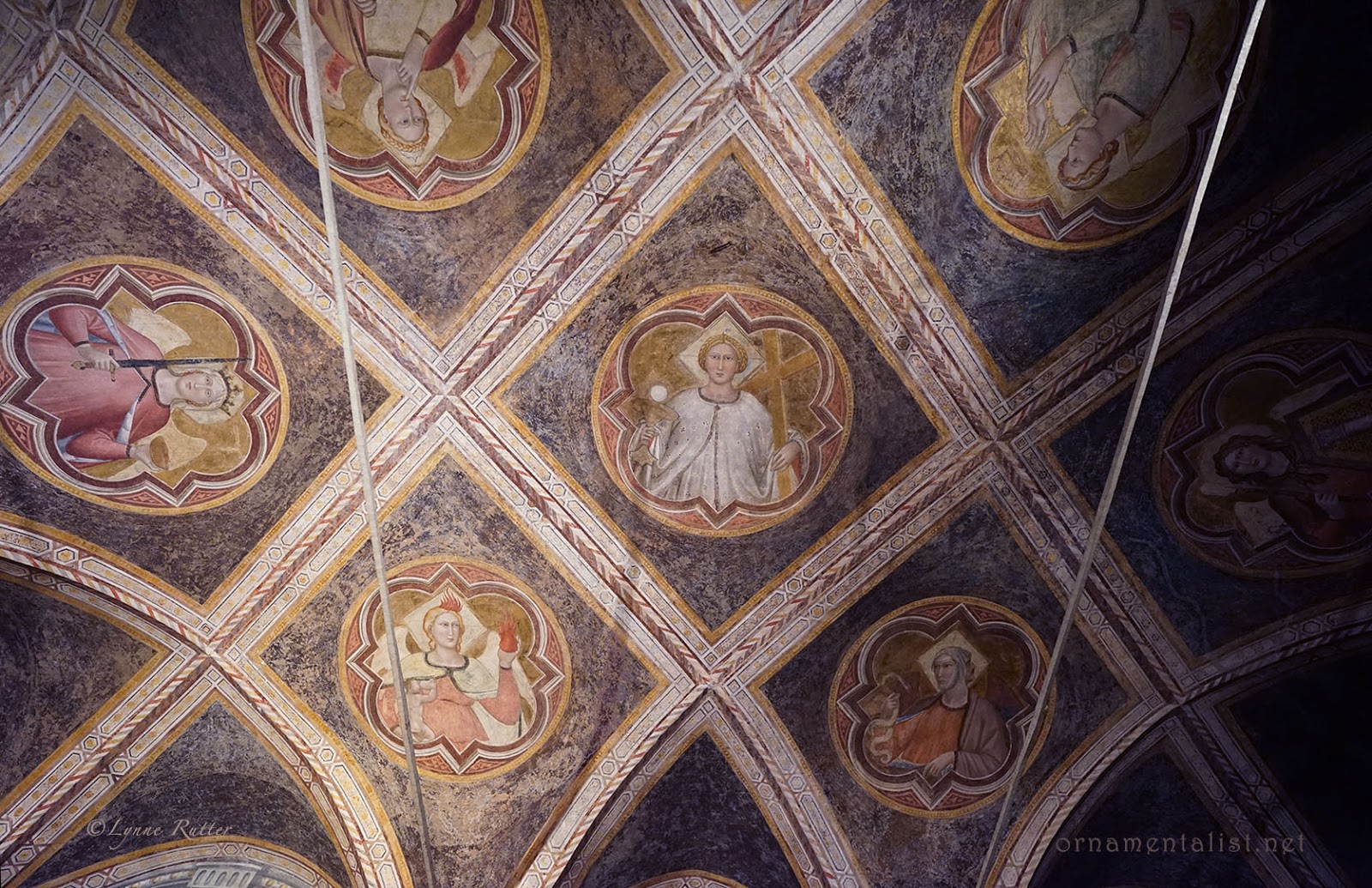
The Crucifixion mural and the ceiling of the Seven Virtues were painted in 1387 by Niccolò di Pietro Gerini, a follower of Giotto. Only traces of blue remain, and this is because blue pigments like lapis lazuli are generally unstable in wet plaster, and so are added over a red or brown base a secco, after the fresco is dry.  These tend to be the first to be lost, leaving the reddish color underneath, and as a result these paintings have an overall warm brown look. (In this case the color is further muddied by the fluorescent lights used in this room.)  The fields on this ceiling also show the ghosts of Giotto-style 8-pointed gilt stars.

A Favorite Detail:  The ribbed groin-vault of this ceiling is a painted effect.  What is actually a rather shallow barrel vault was given the appearance of ribbing by the addition of painted geometric boarders dividing the space into sections. A striped border changes direction, and a painted shadow along one side adds relief, making the ceiling feel taller, more graceful, and more substantial.  Other borders have faux-mosaic "cosmatesque" designs which enhance the illusion and act as frames for the panels.

cosmatesque borders flank the "ribs" of the trompe l'oeil groin vault, Santa Felicità, Florence


The allegorical figures of the Virtues, have square or octagonal halos.  This is, I have learned, a convention to distinguish them from angels or saints. Like saints, the figures are depicted with their attributes:  Fides (faith) holds a chalice with the host;  Charitas (charity) nurses a baby and holds a flame in her hand; Iustitia (justice) wields a sword and scales; Prudenza (prudence) is often depicted with a face on the back of her head and holding a snake; Spes (hope) holds up her hands in payer; Fortitudo (fortitude) carries a shield with a pillar.  Temperanza (temperance) (see first image above) puts a finger to her lips in silence and self-restraint.

The Seven Virtues, ceiling fresco painted by Pietro Gerini 1387,  Santa Felicità, Florence
Murals by Cosimo Ulivelli and Angelo Gori, 1665    Santa Felicità, Florence
The Chapter room and its pronaos (porch) had been open to the cloister on one side, and there had been a lot of moisture damage, but in 1615 this area was enclosed. Then in 1665, the artists Cosimo Ulivelli and Agnolo Gori frescoed the walls with murals and quadratura architecture. 
It's possible the older areas were painted over when the room was remodeled, but despite being aesthetically at odds with the ceiling,  the murals do seem to have been designed to work with it.

Santa Felicità was ordered to close on 11 October 1810, when Napoleon suppressed the monasteries of Florence. The murals were then completely whitewashed over, and have only recently been restored.


Let's review:   
Visits- lost count
Years - three
Cosmatesque ornament- check
Tears- twice (once inside the room) 
Virtues - seven.  No, eight - patience is also a virtue!


Santa Felicità has a new! website with some nice virtual visit links.


All photos in this post by Lynne Rutter, Florence, 2017.  click on images to view larger.


Friday

Grotesque Obsession: Pulchrior in Luce

In which we relive another great moment found by peering through doorways
"Pulchrior In Luce" ~   More Beautiful in the Light
Coffered ceiling with grottesca decoration by Bernardo Poccetti

Wandering along the Borgo Pinti I found the unassuming entry of an austere-looking palazzo with its giant, stud-riddled door wide open.  Flashes of a grottesca ceiling caught my eye in what is currently the entry to a hotel. So naturally  I inquired inside, and learned that it was known as the Palazzo Marzichi-Lenzi, which is the former palace of the Neri-Ridolfi family whose coat of arms is painted in the center of the ceiling.

The painted ornament is attributed to Bernardino Poccetti (1548 – 1612), also known as Barbatelli, a prolific and famous local artist whose work includes the sgrafitto decoration of the Palazzo Bianca-Cappello; the Medici Villa di Artimino; ceiling vaults of the Ospedale degli Innocenti, and the murals in the grand salon of the Palazzo Capponi. Earlier in his career he was known as a great designer of grottesche, in his later years he painted more monumental and naturalistic figurative murals. This ceiling ornament dates from the early 1580's and was beautifully restored by Gioia Germani in 2001.

With its coffered ceiling this space really looks to me like an oddly empty library or even a stripped-out studiolo. The room feels private, even more so because of the esoteric symbolism in the ceiling paintings. As is often the case this palazzo has been remodeled so many times it's hard to say where the original entry was or how this space came to be used in this way.  

The coat of arms of the Neri-Ridolfi family, presented with a double cartouche and festoons of fruit

The ceiling is made up of  almost-square as well as rectangular  coffers, all of which are slightly skewed and in some cases completely wonky, which as a painter I find to be typical in even newly-built coffered ceilings.  I found the lighting in this space to be extremely difficult, and I was compelled to return with a flash (*gasp*), in order to shoot this ceiling.

 So now, let's have a closer look at these marvelous little paintings, shall we?

"Malio Lumina" features the the stone cold glare of Medusa as "Evil Eyes"

Medusa is a familiar face in Renaissance art. In Greek mythology, the gorgon Medusa's very glance could literally petrify a man, turning him into stone, and she came to symbolize the "Evil Eye."  
Perseus set Medusa's severed and bleeding head on the riverbank while he washed his hands, and her blood turned the reeds into red coral. Thus to protect against the Evil Eye one wears or displays branches or beads of precious red coral. 

Spectacular coral piece on display at l’Opera di Santa Maria del Fiore, Florence (nfs)

Red "precious" coral  (see first image "Pulchrior in Luce" above) appears a lot in Renaissance art, as the coral is not only beautiful but is reputed to have both healing and protective properties, and it is sometimes seen as a symbol of Christ's blood. Branches of it appear in treasuries and wunderkammers, portraits and altarpieces.
 (Latin geeks, please weigh in on the play on words in these two panels' mottos- Lumina vs Luce.)

"Suo Succo" - its essense
Visitors to my studio will recognize this emblem which has been tacked to my door for some years.
 
Each of the soffits has symbolic  imagery in the center with a latin motto, resembling the pages of an Emblamata (emblem book) owing in part to the small scale of the individual panels.  However, overall they are just pared-down versions of the same compositions used in many larger grottesche ceilings- with a central image or allegorical figure, corner elements oriented towards the center dividing the panel with an "X",   and symmetrical but not identical pairings of fantastical beasts and ornamental flora. 
Often the grottesche will echo or enhance the central element:  the coral tree is surrounded by pearls, shells, and imaginary sea-creatures;  a bulb springing to life is surrounded by birds, butterflies and garden trellises arranged in a Maltese Cross configuration.  The usual features of the grottesca style are present in masks, birds, vases, harpies and other winged creatures, little garlands and floral scrollwork.

"Tenet Usque" ~ Hold constant
A rudder held straight, surrounded by the four seasons;  the face of the sun with 12 rays, burning torches, harpies (one of which appears pregnant), and landscapes; each detail has some meaning assigned to it.

"Omnibus Idem"~ (the sun shines on) all the same
The exact meaning of this group of images, whether they all reference a particular source, or if they were designed by a scholar or philosopher, is unknown. I approach such things as a painter first and foremost, but years of studying art history tell me there is an interesting story underneath the beautiful painting. In my more recent research I was thrilled to find a detailed 2015 paper on this ceiling by renowned art historian Liana De Girolami Cheney, who clearly knows a lot more about this than I do and has some great insights, but alas, the ornament's true meaning and purpose remains a mystery for now.

"Ex Pulchris Optima Libant"~ from beauty, the best offer

"Te Ipsum" ~ (see)  Thy Self
Is it just me or would these make amazing designs for scarves? 


The Palazzo Marzichi-Lenzi is now home to the Hotel Monna Lisa

all images in this post by Lynne Rutter  2014-2017 


.