Showing posts with label decorative painting. Show all posts

Monday

Heraldry: l'Archiginnasio di Bologna

In which we see the decoration as a message from history.

Heraldry illuminates a stairway of the Archiginnasio, Bologna
The spectacular Palazzo Archiginnasio was built in 1563, to a design by architect Antonio Morandi, as the main campus of the venerable University of Bologna. It houses a world-famous Baroque anatomy theater and since the 1830s has been used as the civic library, preserving a vast collection of antique and modern manuscripts and rare books.  I finally got a chance to visit this winter!

* Central courtyard and loggia of the Archiginnasio  (photo)
What makes this impressive place a destination for the Ornamentalist is the heraldic decoration! Presented in every conceivable manner, the walls and ceiling vaults are encrusted with heraldic arms, which were added continuously until the late 18th century.  Some 6,000 coats of arms commemorate past students, alongside memorials to illustrious  teachers, noble patrons, and church affiliations.

enclosed gallery of the Archiginnasio with the coats of arms of past students
These heraldic devices are more than a brilliant form of decoration, they emphasize the history and international prestige of the academic institution, while their inscriptions and mottos inspire intellectual and moral elevation.  

Stairway of the Artisti, Palazzo Archiginnasio
Two grand staircases lead to the lecture halls of the upper level, which was divided between two schools: one for the Legisti (students of civil and canon law) and the other for the Artisti  (students of philosophy, literature and medicine.)  A dizzying collection of arms covers the walls and ceilings.
The honor of displaying a crest was reserved for those students elected as heads of the nationes (student organizations.) These escutcheons or coats of arms indicate the home country or city of the student, along with the student's name.

Up the stairway of the Legisti, and the Lion of Venice
The antique lecture halls were converted in the early 19th century with rows of bookcases, and now preserve the most important books of the library.  The initial collection came from the closure of the religious orders made by Napoleon. Currently this archive contains over 850,000 volumes and pamphlets including 2,000 incunabula (pre-1501 printed editions); 15,000 editions from the 16th century;  8,500 manuscripts; letters and collections of autographs; as well as prints, drawings, maps, and other materials of immense historical importance.

Sala Rusconi, a former lecture hall, begins an enfilade of library stacks full of rare and important texts.
plaster plaques with more coats of arms hang like fringe around a memorial
Parts of the palace, including the anatomy theatre, were destroyed by a bomb in WWII, but have since been faithfully reconstructed. Evidence of the damage can still be seen where painted decoration is missing, or in the in scorch marks of surviving frescoes.  In some places the names or even the emblems have vanished, but the connection to history remains.

The crests and mottos of even the unknown past students,  emanate a message of history and continuation

a dramatic passageway leading to the lecture halls


all photos in the post by Lynne Rutter
except *  by Guido Barbi.
click on images to view larger.

Archiginnasio virtual visit!


Wednesday

The Seven Virtues of Santa Felicità

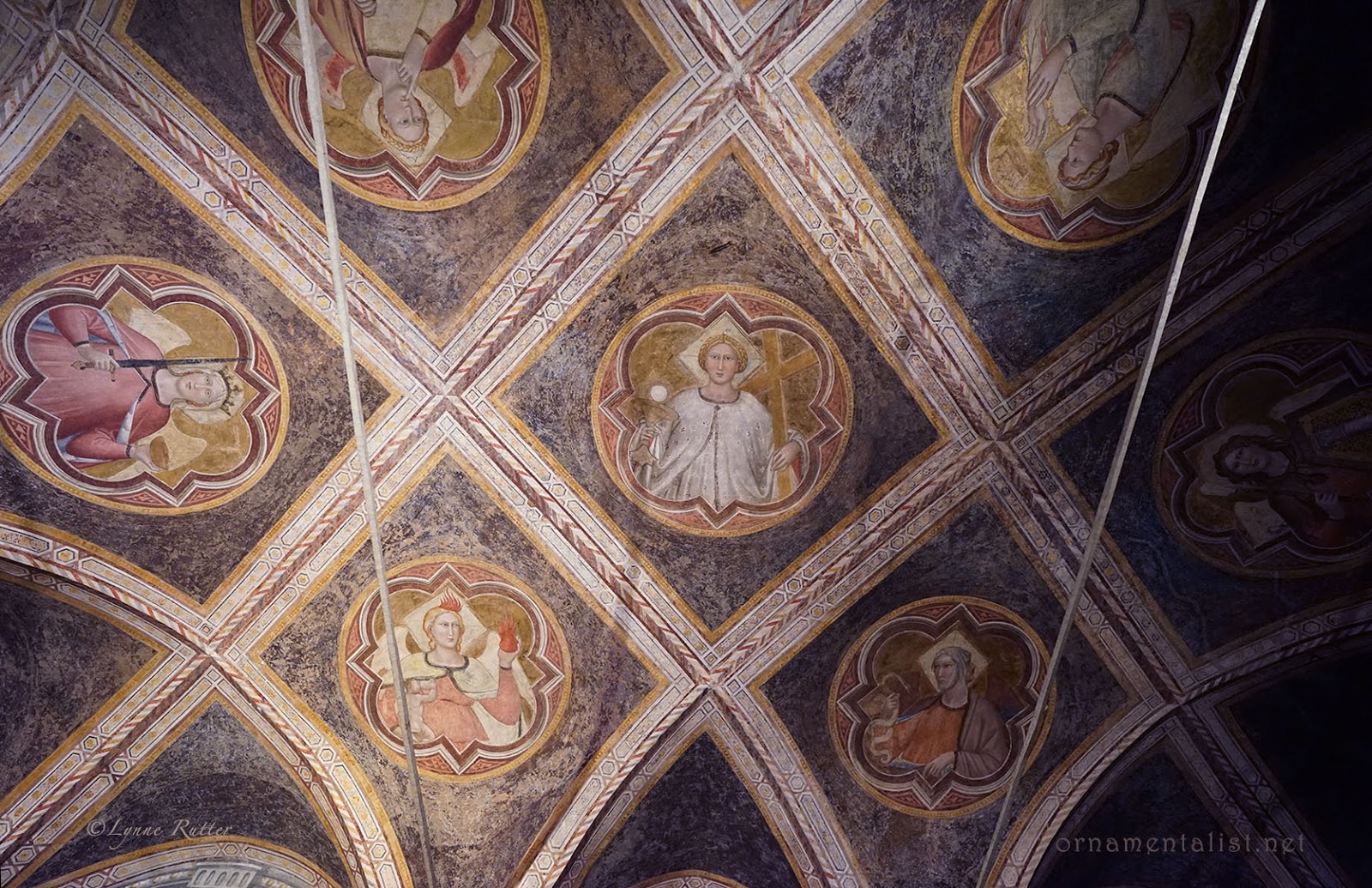
Temperanza, fresco by Pietro Gerini 1387  Santa Felicità, Florence

The Chiesa di Santa Felicità is a small Oltrarno church whose facade holds up part of the Vasari corridor on its way to the Palazzo Pitti.  During my Florentine stay in 2014, I made repeated visits with the goal of seeing the 14th century Sala Capitolare, the Chapter Room,  in the older part of this former Benedictine convent.
I didn’t mind returning so often, and seeing my favorite Pontormo Annunciation in the Capponi Chapel, and the Poccetti murals in the chapel opposite to it.  I became friendly with the volunteer sitting inside the church who would see me coming in just about every week. She knew my name, because I’d given her my card in February, and she pronounced it Leeee-na. She wrote on a slip of paper “venerdi 13-16h” for me, meaning that between 1 and 4 PM on Fridays the Gothic sections of the building are open, and I kept this bit of paper in my wallet.
But every Friday when I returned, she would then say “oh, non oggi, non possiamo aprire la sala… puoi tornare la prossima settimana...” and then “sorry” the only English word she seemed to know. Apparently more volunteers were needed to escort people back there, and she was minding the door on her own.
The very last Friday of April, at the end of my sabbatical, I showed up one last time, and encountered a different volunteer, but the same rejection, and I was deeply embarrassed when my disappointment turned into tears. Why did I need to see this interior so badly? 

A pair of gilt reliquary busts designed for the relics of martyrs, Santa Felicità, Florence.
Earlier this year (2017) I made another visit, this time in a wheelchair having broken my ankle, and was elated to find the Sala Capitolare open, and two extra volunteers on hand to lay a plank on the stairs.  Erling took something of a running start to push me into the room, to the long-for glimpse of the Gothic painting inside. 

The chapter room of Santa Felicità, with a gothic ceiling and baroque murals
The Crucifixion mural and the ceiling of the Seven Virtues were painted in 1387 by Niccolò di Pietro Gerini, a follower of Giotto. Only traces of blue remain, and this is because blue pigments like lapis lazuli are generally unstable in wet plaster, and so are added over a red or brown base a secco, after the fresco is dry.  These tend to be the first to be lost, leaving the reddish color underneath, and as a result these paintings have an overall warm brown look. (In this case the color is further muddied by the fluorescent lights used in this room.)  The fields on this ceiling also show the ghosts of Giotto-style 8-pointed gilt stars.

A Favorite Detail:  The ribbed groin-vault of this ceiling is a painted effect.  What is actually a rather shallow barrel vault was given the appearance of ribbing by the addition of painted geometric boarders dividing the space into sections. A striped border changes direction, and a painted shadow along one side adds relief, making the ceiling feel taller, more graceful, and more substantial.  Other borders have faux-mosaic "cosmatesque" designs which enhance the illusion and act as frames for the panels.

cosmatesque borders flank the "ribs" of the trompe l'oeil groin vault, Santa Felicità, Florence


The allegorical figures of the Virtues, have square or octagonal halos.  This is, I have learned, a convention to distinguish them from angels or saints. Like saints, the figures are depicted with their attributes:  Fides (faith) holds a chalice with the host;  Charitas (charity) nurses a baby and holds a flame in her hand; Iustitia (justice) wields a sword and scales; Prudenza (prudence) is often depicted with a face on the back of her head and holding a snake; Spes (hope) holds up her hands in payer; Fortitudo (fortitude) carries a shield with a pillar.  Temperanza (temperance) (see first image above) puts a finger to her lips in silence and self-restraint.

The Seven Virtues, ceiling fresco painted by Pietro Gerini 1387,  Santa Felicità, Florence
Murals by Cosimo Ulivelli and Angelo Gori, 1665    Santa Felicità, Florence
The Chapter room and its pronaos (porch) had been open to the cloister on one side, and there had been a lot of moisture damage, but in 1615 this area was enclosed. Then in 1665, the artists Cosimo Ulivelli and Agnolo Gori frescoed the walls with murals and quadratura architecture. 
It's possible the older areas were painted over when the room was remodeled, but despite being aesthetically at odds with the ceiling,  the murals do seem to have been designed to work with it.

Santa Felicità was ordered to close on 11 October 1810, when Napoleon suppressed the monasteries of Florence. The murals were then completely whitewashed over, and have only recently been restored.


Let's review:   
Visits- lost count
Years - three
Cosmatesque ornament- check
Tears- twice (once inside the room) 
Virtues - seven.  No, eight - patience is also a virtue!


Santa Felicità has a new! website with some nice virtual visit links.


All photos in this post by Lynne Rutter, Florence, 2017.  click on images to view larger.


Sunday

The Salon- Art Deco in New York City

 In which we are both humbled and inspired...

Pascal Amblard's portrait of fellow painter Sean Crosby

I just returned from New York City, where I participated in the annual confabulation of decorative painters known simply as  "the Salon."  Decorative painters from 18 different countries came together to share their work and techniques with each other and the public.  This year's hosts Arlene McLaughlin and Jeanne Schnupp, chose the theme of Art Deco, a style of decor and architecture inextricably linked with the city of New York.

The exhibition showcases outstanding examples of imitation wood and marble, murals, lettering, gilding, wallpaper design, and trompe l'oeil.  Less visible is the affinity  between these artists and the friendships developed over the years that go well beyond professional camaraderie.

Nowhere was this bond more beautifully expressed than in this mural (left) featuring a portrait of New York artist Sean Crosby painted by his longtime friend and collaborator, Pascal Amblard of France. For a number of reasons this painting had a great emotional impact on me and pretty much everyone else at the Salon.


Karl Groissenberger (Austria) tribute to the Wiener Werkstätte
Austrian painter Karl Groissenberger designed a show-stopper of a panel which celebrates the birth of Modernism in Austria from the Wiener Werkstätte, who for a time also had a shop on 5th Ave in New York. Iconic designs from Josef Hoffman and others are displayed in a blonde walnut art deco bookcase. Along with those shoes.  Those shoes I adore!

Here is but a sampling of some of the great work our international colleagues exhibited this year:

Barre Verkerke (Netherlands) faux marbre with metallic frame and lettering 

detail of a trompe l'oeil piece by Julien Gautier (France)
Exhibit showing work from Tina Davis (USA/Italy) and Lynne Rutter (USA)
Helen Morris (England)  stenciled skyscrapers!
Spectacular faux marbre and lettering by Kristoffer Hermansson (Sweden)
Cathy Chiavaro  (USA)  look closely at the cityscape
Friederike Schulz (Germany) painted a classic deco-era German wallpaper design
Petr Dashchenko (Russia) A superb tribute to Soviet-era Art Deco.
Detail of painting by Stefano Luca (Italy)
glossy book jackets painted by Valerie Naulleau (France)
A gargoyle of the Chrysler Building framed in faux bois/marbre by Gert-Jan Nijsse (Netherlands) 

Next year the Salon travels to Leeuwarden, Friesland, in the Netherlands.


photos in this post by Lynne Rutter
Many more images of this year's Salon can be found at Salon NYC 2017 on Facebook
\\//


Monday

Studio Visit: Alison Woolley

A Florentine studio where Renaissance finishes meet contemporary design.
A circus performer flips in Alison Woolley's gilded artwork

Here I am again in Florence making lots of visits to my friend Alison's studio, on the top floor of a vintage stone palazzo filled with light and packed with samples, gilding tools, pigments, painted furniture, and at least two harpsichords-in-progress.

Long known for her  gilding work,  traditional harpsichord decoration,  and distinctive Florentine painted furniture, Alison Woolley has in recent years been expanding more into contemporary design. 
"I love nice craftsmanship and design and it doesn't matter what period," Alison tells me. "I do enjoy clean lines and I love that about the mid-century modern. Florentine Renaissance style often has clean lines, lovely large proportions, and very rich surfaces."
The juxtaposition is a harmonious one for an aesthetic shared across 600 years.

Gilding, painting, and patterns at Alison Woolley's studio
Alison Woolley's office features hand-painted walls with a mid-century aesthetic


In the design office of Alison's studio, an Art Deco style mirror hangs on hand-painted walls inspired by 1970s wallpaper designs. The bold scale of the pattern is surprisingly effective.

"The different values of the circles create a feeling of space so the pattern on the walls has made the room feel more spacious than it did before when the walls were white. I have a carefully chosen colour scheme that ties everything together."


Gilded Art Deco detail in a faux tortoise mirror frame by Alison Woolley.
A native of Toronto, Canada, Alison moved to Florence in the late 1980s, and worked for 15 years under the guidance of Florentine master artisans, prior to opening her own bottega in the heart of the artisan district.  A specialist in harpsichord decoration, Alison uses historic materials and techniques for this exacting work, which she in turn applies to furniture, textile designs, and artwork. Recently she has designed custom Italian Stencils for California-based company Royal Design Studio, as well as scarf designs for the Italian fashion house Salvatore Ferragamo.

Her teaching studio is world-famous, drawing students and commissions from 5 different continents. 

Alison Woolley  in her studio with the Italian harpsichord case she designed for L'Opéra Royal de Versailles
sample for a French harpsichord case (L) and a gilt floral panel by Alison Woolley


Living and working in Florence for 30 years  has given Alison a life full of inspiration.  It's not just the old city, rich with historic artwork, architecture, and decoration,  but the natural beauty of Tuscany,  which has inspired its artists for centuries, and helped to create a environment that celebrates  a high level of artisanship in every aspect of life, from art and architecture to  fashion and food.

"I have been collecting photos of simple grates that I see around here. I love the idea of a craftsman who has the task of making a practical grate, 500 years ago or 40 years ago, and puts that extra thought into it to make it aesthetically pleasing. "

"Circus" by Alison Woolley  - diptych of painted and incised 22 karat gold 
Among the traditions of Florentine art is the fondo oro - the ornamented gold fields seen in the Gothic and Early Renaissiance work of the 13-15th centuries by artists such as  Duccio, Giotto, and Domenico Veneziano, which relates directly to the Byzantine work of the 11th-12th centuries.  Gilt gesso panels embossed with patterns and incised with designs celebrate the rich gold surface and serve as the support of a painted figure or scene.  These same historic techniques are beautifully integrated into Alison Woolley's decorative commissions as well as her fine art work. 

Gilt and painted finishes by Alison Woolley


You can see more of Alison Woolley's work at  WoolleyStudio.com
and check the classes offered  via FlorenceArt.net  in Florence, Italy


Lynne Rutter Studio will be hosting Alison Woolley for two classes in San Francisco:
Florentine Gilding Techniques
August 24-26, 2017
and
Renaissance Finishes for Contemporary Design
August 28-30, 2017


all photos by Lynne Rutter
except nº 3 courtesy Alison Woolley


Friday

Grotesque Obsession: Pulchrior in Luce

In which we relive another great moment found by peering through doorways
"Pulchrior In Luce" ~   More Beautiful in the Light
Coffered ceiling with grottesca decoration by Bernardo Poccetti

Wandering along the Borgo Pinti I found the unassuming entry of an austere-looking palazzo with its giant, stud-riddled door wide open.  Flashes of a grottesca ceiling caught my eye in what is currently the entry to a hotel. So naturally  I inquired inside, and learned that it was known as the Palazzo Marzichi-Lenzi, which is the former palace of the Neri-Ridolfi family whose coat of arms is painted in the center of the ceiling.

The painted ornament is attributed to Bernardino Poccetti (1548 – 1612), also known as Barbatelli, a prolific and famous local artist whose work includes the sgrafitto decoration of the Palazzo Bianca-Cappello; the Medici Villa di Artimino; ceiling vaults of the Ospedale degli Innocenti, and the murals in the grand salon of the Palazzo Capponi. Earlier in his career he was known as a great designer of grottesche, in his later years he painted more monumental and naturalistic figurative murals. This ceiling ornament dates from the early 1580's and was beautifully restored by Gioia Germani in 2001.

With its coffered ceiling this space really looks to me like an oddly empty library or even a stripped-out studiolo. The room feels private, even more so because of the esoteric symbolism in the ceiling paintings. As is often the case this palazzo has been remodeled so many times it's hard to say where the original entry was or how this space came to be used in this way.  

The coat of arms of the Neri-Ridolfi family, presented with a double cartouche and festoons of fruit

The ceiling is made up of  almost-square as well as rectangular  coffers, all of which are slightly skewed and in some cases completely wonky, which as a painter I find to be typical in even newly-built coffered ceilings.  I found the lighting in this space to be extremely difficult, and I was compelled to return with a flash (*gasp*), in order to shoot this ceiling.

 So now, let's have a closer look at these marvelous little paintings, shall we?

"Malio Lumina" features the the stone cold glare of Medusa as "Evil Eyes"

Medusa is a familiar face in Renaissance art. In Greek mythology, the gorgon Medusa's very glance could literally petrify a man, turning him into stone, and she came to symbolize the "Evil Eye."  
Perseus set Medusa's severed and bleeding head on the riverbank while he washed his hands, and her blood turned the reeds into red coral. Thus to protect against the Evil Eye one wears or displays branches or beads of precious red coral. 

Spectacular coral piece on display at l’Opera di Santa Maria del Fiore, Florence (nfs)

Red "precious" coral  (see first image "Pulchrior in Luce" above) appears a lot in Renaissance art, as the coral is not only beautiful but is reputed to have both healing and protective properties, and it is sometimes seen as a symbol of Christ's blood. Branches of it appear in treasuries and wunderkammers, portraits and altarpieces.
 (Latin geeks, please weigh in on the play on words in these two panels' mottos- Lumina vs Luce.)

"Suo Succo" - its essense
Visitors to my studio will recognize this emblem which has been tacked to my door for some years.
 
Each of the soffits has symbolic  imagery in the center with a latin motto, resembling the pages of an Emblamata (emblem book) owing in part to the small scale of the individual panels.  However, overall they are just pared-down versions of the same compositions used in many larger grottesche ceilings- with a central image or allegorical figure, corner elements oriented towards the center dividing the panel with an "X",   and symmetrical but not identical pairings of fantastical beasts and ornamental flora. 
Often the grottesche will echo or enhance the central element:  the coral tree is surrounded by pearls, shells, and imaginary sea-creatures;  a bulb springing to life is surrounded by birds, butterflies and garden trellises arranged in a Maltese Cross configuration.  The usual features of the grottesca style are present in masks, birds, vases, harpies and other winged creatures, little garlands and floral scrollwork.

"Tenet Usque" ~ Hold constant
A rudder held straight, surrounded by the four seasons;  the face of the sun with 12 rays, burning torches, harpies (one of which appears pregnant), and landscapes; each detail has some meaning assigned to it.

"Omnibus Idem"~ (the sun shines on) all the same
The exact meaning of this group of images, whether they all reference a particular source, or if they were designed by a scholar or philosopher, is unknown. I approach such things as a painter first and foremost, but years of studying art history tell me there is an interesting story underneath the beautiful painting. In my more recent research I was thrilled to find a detailed 2015 paper on this ceiling by renowned art historian Liana De Girolami Cheney, who clearly knows a lot more about this than I do and has some great insights, but alas, the ornament's true meaning and purpose remains a mystery for now.

"Ex Pulchris Optima Libant"~ from beauty, the best offer

"Te Ipsum" ~ (see)  Thy Self
Is it just me or would these make amazing designs for scarves? 


The Palazzo Marzichi-Lenzi is now home to the Hotel Monna Lisa

all images in this post by Lynne Rutter  2014-2017 


.

Monday

The Hermitage: four times in a week

In which we make repeated visits to the world's most fabulous museum and find we are not a bit jaded.
"The Gallery of the History of Ancient Painting" in the Hermitage, St. Petersburg.

I had the good fortune to attend the International Salon of Decorative Painters, held this year in St. Petersburg, Russia. This annual gathering attracts many of the finest painters in my field, from dozens of countries and several continents, and this time was well-attended by incredibly skilled Russian artists as well.   The venue for this event, the Exhibition Center for the St.Petersburg Union of Artists,  is a short walk to one of the greatest museums in the world, the Hermitage. 
Like other major museums, the Uffizi, the Met, the Louvre, it cannot be done in one visit, it's too overwhelming. So I popped over every chance I got. The Hermitage is open late on Wednesdays and Fridays.
The museum is famous for its prodigious art collection, the Rubens paintings and sketches, and countless masterpieces of European art, but as usual, I was staring at the ceilings, walls, huge malachite urns, marquetry floors- because this building is first and foremost one of the most gloriously decorated palaces in the world.

Exterior of the Hermitage, painted with a distinctive and inspiring malachite green, ochre, and white color scheme

Just as in the (amazing film) Russian Ark, even the most organized tour through the Winter Palace will prove bewildering. The decor alone encompasses 300 years of Russian History. The collections reach through millennia. 

I forget what this room is for. Let's ring for tea, shall we?
Rococo styled rooms give way to Neoclassical spaces and "Russian Empire" style, and everything in between. Some interiors are pure fantasy.  I loved it. Every minute of it.

Ceiling detail from the lovely blue and white room used as the "silver cabinet"
Walls covered in gold leaf need plenty of candlelight to show it all off
In every space, gilding of a particular rosy color of gold leaf is used to great effect. OK I admit, in some cases, maybe it's over-used.  Nevertheless, the sheer level of craft is awe-inspiring.

nice example of Russian Neoclassicism in this trompe l'oeil ceiling
The Empire style found a great place in Russian design.  Large quantities of malachite were mined in the Ural Mountains and the famous Ural mosaic techniques were used to create columns, table tops, giant urns. A fairly liberal use of this intense green stone made for some eye-popping Empire interiors.

Gold and Malachite go so well together
Interior of the Malachite Room of the Hermitage, as painted by Constantine Andreyevich Ukhtomsky in 1885 image via hermitage.org
One of my favorite rooms is the"Gallery of the History of Ancient Painting." A long hall which houses a collection of white marble figures by Italian sculptor Antonio Canova (1757-1822) and his followers.

"The Gallery of the History of Ancient Painting"  neoclassical design by  Leo von Klenze
The walls and ceilings of the gallery are decorated with grottesca (or grotesque) ornament in a vaguely Pompeiian scheme. Insets panels of encaustic paintings on brass plaques by Georg Hiltensperger are meant to illustrate ancient painting techniques.

Encaustic paintings by Georg Hiltensperger depict ancient painting techniques.

Still from the film "Russian Ark"  in which the Stranger wanders into the Raphael Loggia
The most breathtaking space of all, has to be the gallery known as the Raphael Loggia.  Designed by Giacomo Quarenghi and painted by Cristopher Unterberger and his workshop in the 1780s, the loggia was commissioned by Catherine the Great as a replica of the Vatican Loggia in Rome, originally frescoed by Raphael and his atelier in 1512.   

Raphael Loggia in the Hermitage
Grottesca detail of the Rapahel Loggia of the Hermitage
These paintings are of course clean and new looking, but by most accounts they are a faithful and direct copies of the Vatican originals, having been painted on site using tempera on canvas. The canvases were then sent to St. Petersburg for installation. Mirrors replace the Vatican windows, reflecting the northern light. And then there is that rosy color of gold trimming each panel.  The magic of this scene is difficult to describe. 
    
Hermitage Raphael Loggia
The jawbone of an ass- detail in the Raphael Loggia, Hermitage
Grottesca detail- from 1512 to the 1780s


The Hermitage Museum website has many lovely images, including 360 degree panoramas of entire rooms in their "virtual visit" feature.


21st century decorative artists:
Photos from Salon 2016 at Flickr


All photos in this post by Lynne Rutter unless otherwise noted,  May 2016. Click on images to view larger.