Showing posts with label chinoiserie. Show all posts

Thursday

Studio Visit: Jennifer Carrasco

Ship of Fools:   Chinosierie mural detail by Jennifer Carrasco*

So a couple of years ago, I get this email from my friend Jennifer Carrasco asking about canvas for a big job... I love talking shop with my fellow muralists and I was happy to dump all sorts of advice on her whether needed or not.  For the next year or so there was a lot of back and forth about the technical and physical challenges of this huge commission of Chinoiserie, which Jennifer designed in a highly personal style including many details that resonated with her client's personality and philosophy.  The 20 foot high mural panels were painted for a fabulous home on Vashon Island, creating a truly over-the-top fantasy rivaling anything you can find in Brighton or Drottningholm. 

Jennifer Carrasco in the fantastic Chinoiserie mural she created for her client on Vashon Island*

As I am a huge fan of Jennifer and her work I was very excited to get a chance to visit her Seattle garden studio after Salon 2014 was held in Seattle last May,  just after this stupendous mural had been installed.

Jennifer in her studio, scale drawing of her Chinosierie mural
Surrounded by her garden,  Jennifer's studio is a charming and compact creative space cleverly outfitted to her needs thanks in large part to the carpentry genius of her partner, Phil.

Large projects require enormous amounts of organization and planning, especially when being produced in smaller spaces.  The entire chinoiserie project was designed and laid out in a scale drawing overlaid with a carefully numbered grid, the staggered panels were measured and cut in a large sail loft, and then sent to a commercial paint shop to be spray painted with the gradated colors of the background, then the grid transferred to the canvas.

Phil designed an ingenious system to allow Jennifer to paint these 20+ foot high mural panels in this studio, by devising  two stations with "drafting table" style painting areas and  pairs of rollers to dispense and roll up the canvas.  This way Jennifer can paint seated at a large, angled table rather than standing on ladders, or sitting on the floor or any of the other difficult postures we  have to assume when doing large pieces   Jennifer bragged to me early on that this set up "has added years to my mural painting life."

Inside and outside, Jennifer Carrasco's garden studio in Seattle
This clever mural painting set-up allows for comfortable ergonomic painting while seated.*
behind the mural painting wall is beautifully organized storage 


I really loved the storage opportunity that was built into the back of the painting wall.  I'm afraid I am the type to get rather too excited about such things.

In addition to this charming style of Jenoiserie, as she calls it, Jennifer is well known for illustration work and for painting  fearlessly colorful murals and environments such as the famous ballroom of the Seattle restaurant The Ruins.   Her work is infused with humor, nature and pure joy.    You can see more of her paintings at her beautiful website.

 
Selected Jenoiserie is also available now via Spoonflower in fabric, wallpaper and other printed items!!

Chinoiserie peonies by Jennifer Carrasco*

color samples and sketches at Jennifer Carrasco's studio


Photos in this post by Lynne Rutter
and *courtesy Jennifer Carrasco


International Decorative Painters Salon


Tuesday

In Memoriam: Garth Benton

Mural by Garth Benton in the Outer Peristyle at the Getty Villa, Malibu CA.  via Flickr

Garth Benton in 1994

This week I was saddened to learn of the passing of a great muralist, Mr. Garth Benton, an internationally recognized artist who was well known for his stylish first-century style trompe l'oeil decoration of the magnificent Getty Villa in Malibu, California. 
Mr. Benton "died a after with battle cancer" in May of 2012. I am surprised I did not see it reported anywhere and I only figured it out after I noticed that his website had gone down and began making inquiries.  Being a pre-internet personality Mr. Benton was not widely mentioned on the web,  but his work was nevertheless world-class, and very well-known in its day.
 trompe l'oeil bas-relief painted by Garth Benton

I had the pleasure of working on a project with Garth Benton many years ago when he came to San Francisco to paint some spectacular Chinoiserie murals in a private residence here.  He had arrived in town with inexplicably blank wallpaper apparently intending to paint the murals on site, but with no help and nowhere near enough time.  I got a desperate call from the wallpaper hanger (who knew I also paint in this style) and rather than ask what the heck had gone wrong, out of respect for this great master painter  I put my nearly entire studio at Mr. Benton's disposal - scaffolding, buckets, tarps, ladders, brushes, and as many assistants as I could round up - and we all learned a lot from him while helping him complete his commission, some of the crew often working until 3 AM or even all night, trying to meet the deadline.  While we painted, we were regaled with entertaining stories about his many celebrity clients and amazing jobs he'd done over the years.  It was exhausting and exciting and the job was truly beautiful.
Ballroom mural by Garth Benton in the Getty Residence, San Francisco

A couple of years later Mr. Benton made headlines for suing his clients, Ann and Gordon Getty, for having painted over one of his older murals in their San Francisco home, which he had hoped to photograph for a glossy catalogue raisonné of his work. The mural had been painted on canvas and could easily have been removed, but the Gettys had not realized this when they redecorated, and had to settle a large amount of money on him for the error.  While I felt deeply over the heartbreaking loss of the artwork, the case made me cringe: suing an otherwise supportive client likely didn't help his future business. The mural is still gone and the book was never published. 
A Chinoiserie mural painted by Garth Benton for Michael Taylor Design in the 1980s

We exchanged a few emails over the years,  but regrettably never did get to meet again.

So I offer this short tribute to Mr. Garth Benton, to be remembered for his fine work, and his influence on a generation of muralists.

images 2-5 via Internet Archive


Saturday

Evening in the Forbidden City

an emperor portrait painted for the San Francisco Opera opening night gala
Patrons attending the opening night of the San Francisco Opera on Friday were  treated to a colorful performance of Puccini's Turandot as well as  a special gala dinner in a majestic tented Opera Ball Pavilion, An Evening in the Forbidden City.
Event designer Robert Fountain commissioned me to help decorated the pavilion with  large scale portraits of Chinese Emperors. Of course this is right up my alley so of course I said yes.
the ghostly apparitions of Emperors in my studio
Melinda's clear favorite was the kindly old emperor in the vermillion robe.
 
With only about a week to paint these,  I called in my friend and colleague, Melinda Morey.  We had a brilliant time working together!  We were fairly literal in our painting technique - using a period  Chinese style and including a lot of rich pattern.  I was especially thrilled to be using such pure, saturated color for the magnificent robes of the Emperors: vermillion, gamboge, pure cadmium yellow, indigo, kingfisher blue...
 Emperors in the studio just after completion

Lynne with three of the 9 foot tall paintings


The Gala Pavilion was fabulously draped entirely in red, and the portraits hung and lit to great effect.
After the opera, the party continued with dancing in the Hall of the Emperors.


More inspiration:  
Bertoclucci's The Last Emperor 
Twilight in the Forbidden City by Reginald Johnston


Murals for special events?  Why, yes!

The Enduring Appeal of Chinoiserie

A History of a Style

Chinoiserie... that inventive fusion of Asian motifs and European sensibilities, can be whimsical, graceful, and theatrical. A major design phenomenon in the 17th and 18th centuries, it continues to be one of the most enduring and fanciful decorative styles in interior design.
  Japanned wardrobe by Thomas Chippendale  image ©NTPL/Andreas von Einsiedel
Interior design and mural painted by Lynne Rutter 
2002 San Francisco Decorator Showcase

I became fascinated with chinoiserie through years of restoring  and repairing hand-painted wallpapers and pieces of “japanned” furniture,  studied its history and techniques, and eventually started painting some of my own designs in similar fashion.

It seems to me that every era has created its own version of chinoiserie,  to emphasize exoticism and escape, or sometimes to be simply colorful and uplifting. In all cases there is a fairy tale dream-like quality that never fails to be charming.

It all began long ago, in a land far, far away…


A Style is Born:
Increased trade between Europe and China  in the 17th century sparked a passion for all things oriental. What started with imports of commodities like tea, porcelain, silk, and saltpetre,  grew to include a new cargo:  a revolution in design.
The growing vogue for rare chinois artifacts inspired fanciful  imitations from skilled artisans all over Europe.  Oriental motifs both real and imagined, with pagodas, birds, monkeys, and figures in exotic costume, were worked into all manner of  fine and decorative arts: everything from garden teahouses to japanned tea boxes were created in a Europeanized oriental fashion. An original and new style was born- not just from the Chinese influence – but far more from the inspiration borne of it.
Fantastic interior design ensued.

A subgenre of Chinoiserie, Singerie features monkeys in exotic costume doing playful and naughty things. Grande Singerie Murals by C. Huet, 1737 Château de Chantilly, France  image: Atelier Mariotti

The new decorative style was popularized by the French court of Louis XV, as the curves and whimsy of Chinoiserie integrated beautifully with Rococo architectural features.  Soon it became all the rage, with all the royal palaces of Europe creating glittering theme rooms and entire pavilions to house their collections of oriental treasures.
 Jean-Baptiste Pillement’s 1760 book of engravings  “The Ladies Amusement or The Art of Japanning Made Easy”  was reprinted in England and became an influential sourcebook for designers of Chinoiserie.  image from Lynne's collection

Over the next hundred years the mania for Chinoiserie spread across the Western world, in fashion, furniture, and interiors, even in theater and opera. No palazzo, schloss, or manor home was quite complete without its Chinese room.  In early American interiors Chinese objects and fine, hand-painted wallpapers played a significant role and influenced design in the young United States for generations to come. For a growing nation that longed to be part of the rest of the world, the blending of eastern and western cultures was a symbolic and powerful idea.
circa 1780 Chinese painted wallpaper, in a room in Colonial Williamsburg, VA, was previously hung in a house in Boston. image via Carlton Hobbs
Painted Papers: The Flowering of Chinoserie
Early in the 18th century,  the first hand-painted wallpapers were imported from China by the East India Company, and so were  sometimes called  “India papers.”  Produced in China exclusively for the western market, they featured exotic looking flora and fauna delicately painted in brilliant colors on paper silk.  You can see breathtaking examples of these early India paper murals in the Chinoiserie rooms of historic palaces at Hellbrunn, Salzburg, Austria; Oranienbaum,  Russia; Drottningholm, Sweden;  Sans Souci, Potsdam, Germany; and  Schloss Charlottenburg, Berlin.  At Nostell Priory in Yorkshire,  famed English designer Thomas Chippendale used floral wallpaper murals in rooms filled with faux bamboo chairs and  japanned cabinets.
.
Gallery in the Royal Pavilion at Brighton image via Wikipedia

Then, when you think you’ve seen everything, there’s the Royal Pavillion at Brighton,  the spectacular pleasure palace built for King George IV.  Completed in 1822, and is the ultimate example of the late Chinoiserie style, with its opulent,  fanciful interiors and room after extravagant  room filled with handpainted Chinoiserie papers, ornament, and ceiling murals.

An Enduring Style
18th century classicists argued that the Chinoiserie style was ‘a ridiculous hodgepodge of serpents, dragons, and monkeys’  and maybe it was,  but then, even the most understated neoclassical Georgian house often had rooms whimsically decorated with floral murals “in the Chinese taste;”  a pagoda folly in the garden;  surely a pair of gilt brackets with blue and white porcelain vases, at the very least.   Robert Adam himself more than likely trotted about his home in a banyan and turban, as did most gentlemen of his day.
Chinoiserie meets the age of speed in the the Art Deco smoking room of the cruise ship “Empress of Britain” c. 1930

A general revival of orientalism in the late 19th century found theatrical Chinoiserie theme rooms at the height of fashion once again in Victorian homes, providing a serene escape from bustling industrialized cities.     From boudoirs to movie palaces,  Chinoiserie figured gracefully into Art Deco and “Hollywood Regency”  interiors, the exotic orient representing languor and wistfulness in an era of speed and new technology.   Throughout  the 20th century designers  from Sister Parish to Tony Duquette used Chinoiserie to add opulence, color, and grace to their designs.
Grant Gibson‘s design for the 2010 Elle Decor Showcase, wallpaper by deGournay

Now considered a “classic” look, chinoiserie is very much on-trend as a versatile component in contemporary interiors.  Wallpapers are still being painted in China for companies like by DeGournay, Gracie, and Fromental, and are in high demand all over the world. Contemporary muralists Jennifer Carrasco, Scott Waterman,  Nora Johnson, and of course, Lynne Rutter, have all painted current styles of chinoiserie for their clients, each with a different spin on the traditional form, while top interior designers are incorporating chinioserie murals, furnishings, and accessories into their work in fresh new ways.

Is this a Chinoiserie revival, or the perennial flowering of an immortal style?


Further Reading:
Chinese Wallpaper in Britain by Emile de Bruijn: the author of one of my favorite blogs has finally put out a fabulous book with great images and information about the Chinoiserie papers I adore!!


Flowering Chinoiserie:  Painters who share this obsession may want to consider taking this  workshop on creating your own chinoiserie murals!


©Lynne Rutter 2011


Tuesday

Postcard from Berlin

Chinesisches Haus, Sanssouci, Postsdam
We've been visiting Berlin and environs for the last two weeks. Many lovely pictures. Stay tuned!
 

Chinoiserie, Italian Style

Sala Cinese, Palazzo Moroni, Bergamo
Chinoiserie is still one of my favorite styles of decoration. All the rage in Europe in the late 17th and 18th centuries, it endures as a classic style of "theme" room, a fantastic mix of exotic Asian motifs and European techniques and sensibilities. One of the most charming examples I have ever seen is this room in the Palazzo Moroni, in Bergamo.
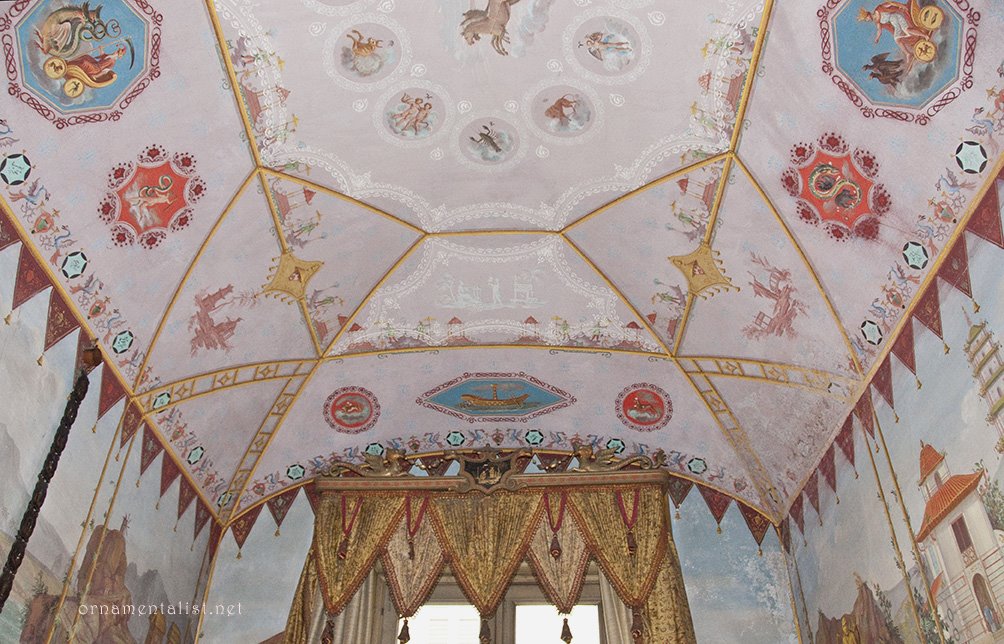
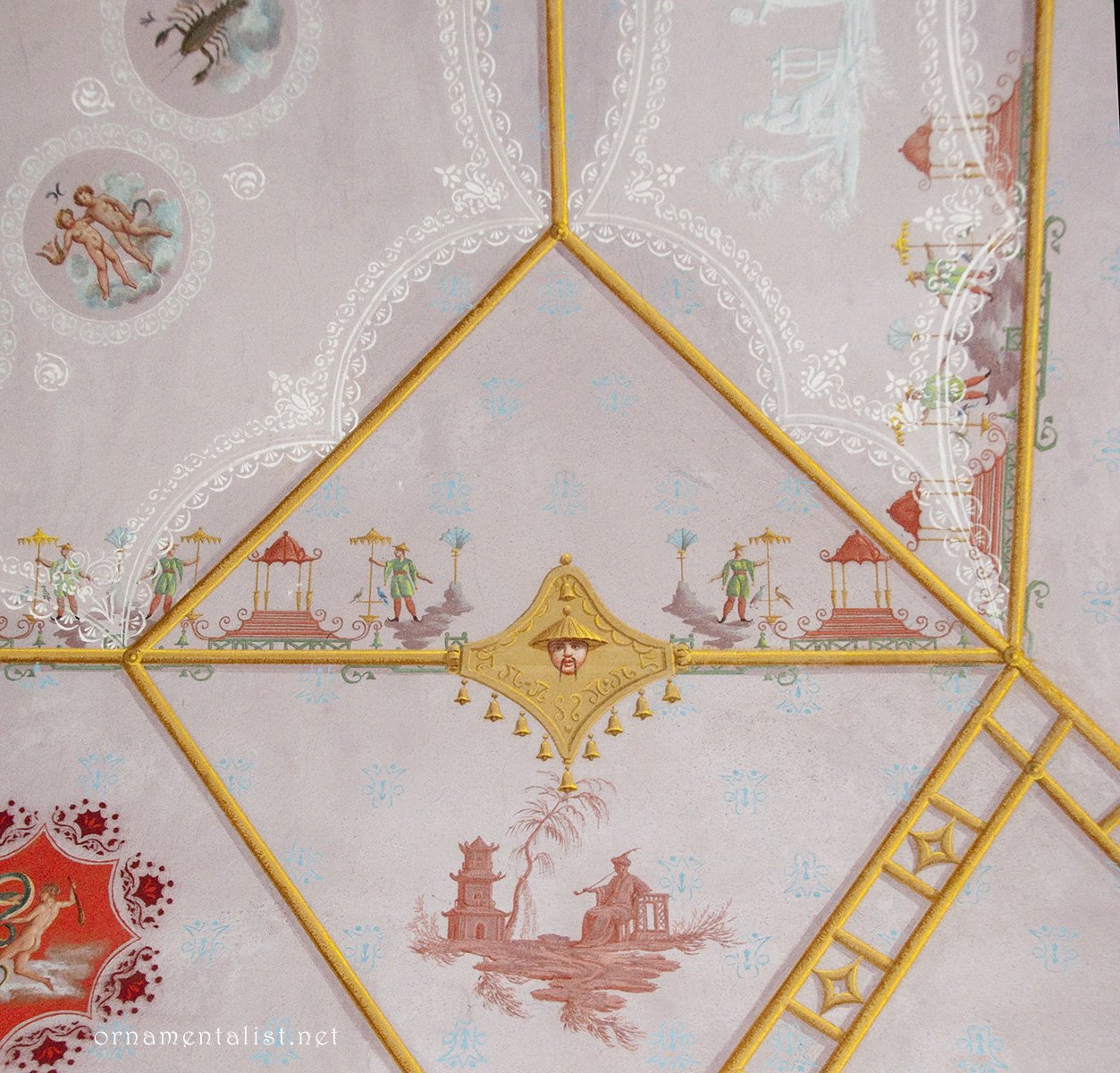
The ceiling appears to be a colorful pink tent, with a lace "cap" at the top, the signs of the zodiac at its center.
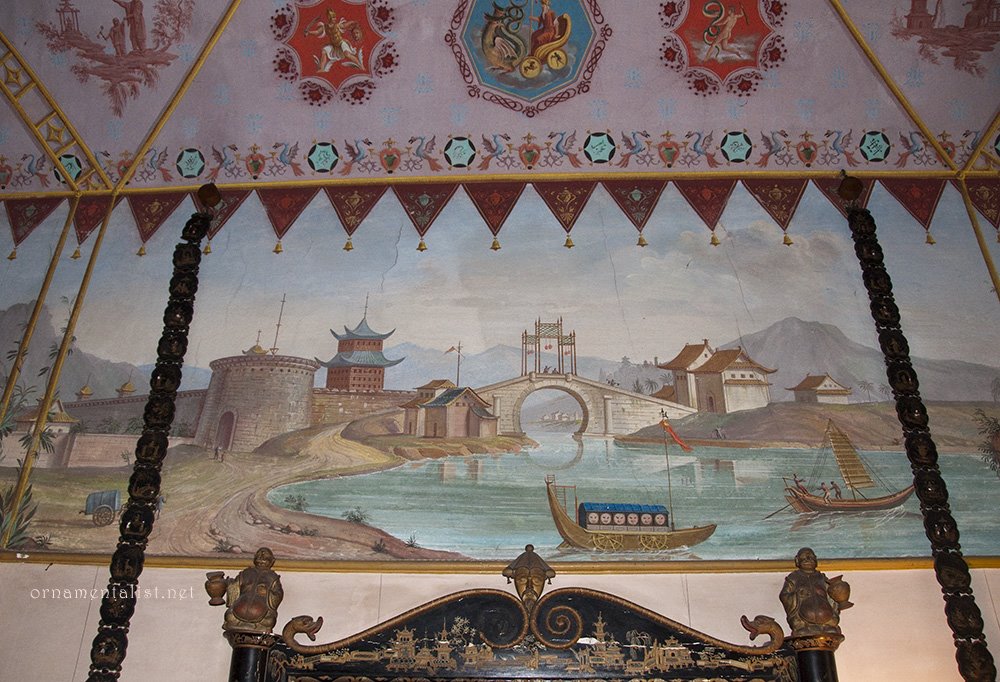
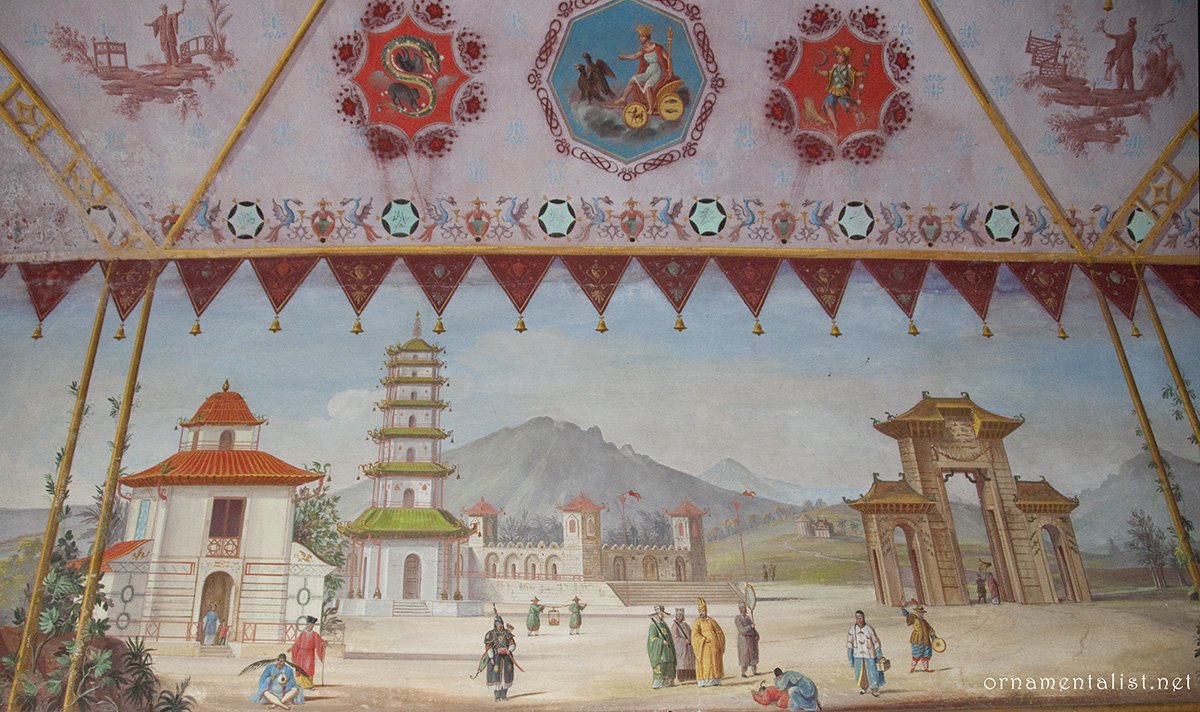
detail from the Sala Cinese, Palazzo Moroni
Excellent landscape murals surround the "frieze" level of this room. Note the perspective in the paintings, which are all viewed from below.

Detail of the ceiling: I just adore that lace edging, and the border of little pavilions.

These fantasy buildings remind me of San Francisco's Chinatown, whose architecture was designed in 1906, to reflect the western impression of ancient Chinese buildings. Obviously not a new thing.

I visited the Palazzo Moroni during the International Decorative Painting Salon which was held in Bergamo earlier this year. Our gracious host for this event was Lucretia Moroni,  scion of the Moroni family, and herself a world-renown decorative artist. As you can imagine the group of painters visiting this palazzo were very appreciative of its historic murals and terribly grateful to be allowed to take pictures.


photos by Lynne Rutter, April 2009
click on images to view larger


Joy Prevails Over Apathy


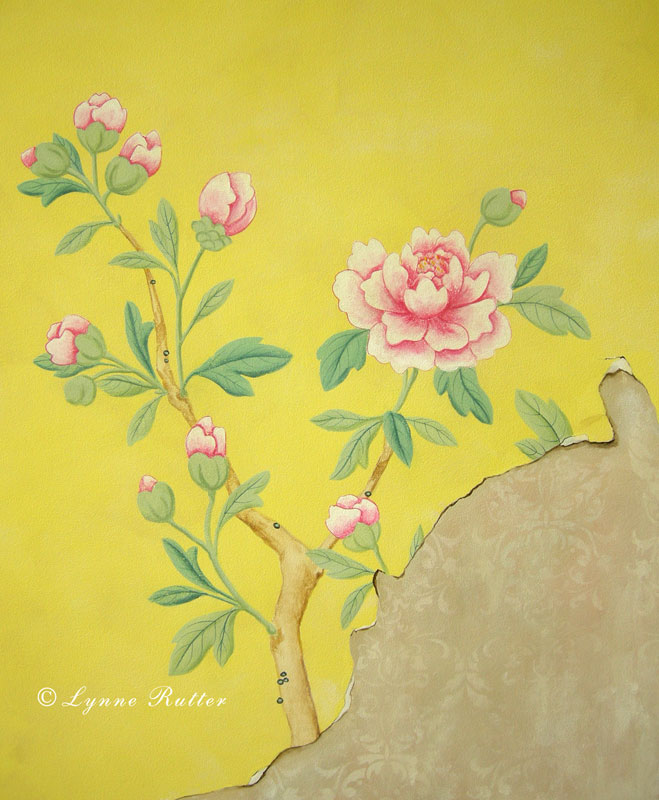
Every year some team of experts decides what the "color of the year" is going to be, and for 2009, it's a certain color of yellow. I had already been working on this panel of chinoiserie using a bright Imperial Yellow field when I heard this "news."
Interesting how these "fashions" in wallpaper, trends in paint, styles and colors, come and go, and come back again. The myth here is that anything is ever really all that new.

My painting above has a trompe l'oeil illusion, of brightly colored chinoiserie paper being torn up from its predecessor, the monochromatic neoclassical stencil pattern. Don't get me wrong, I love neoclassical design, but these days I feel a need for color. I find myself attracted not to just one color, but the combination of them, and I come back to this bright yellow every so often because it makes me happy. I felt, every moment I worked on this painting, basking in yellow, the sensation of pure joy!

So to me this painting is about the triumph of joy. The joy of color dominating the innocuous, monochromatic style; the joy of vision over nostalgia; of radiating rather than retreating.


Arts and Crafts Flowering Frieze

Some months ago I completed work in this unique project for the Malibu home of the illustrious Ms. Barbra Streisand. The design of the library was inspired by the "Ultimate Bungalows" built by notable Arts and Crafts architects, Greene and Greene.
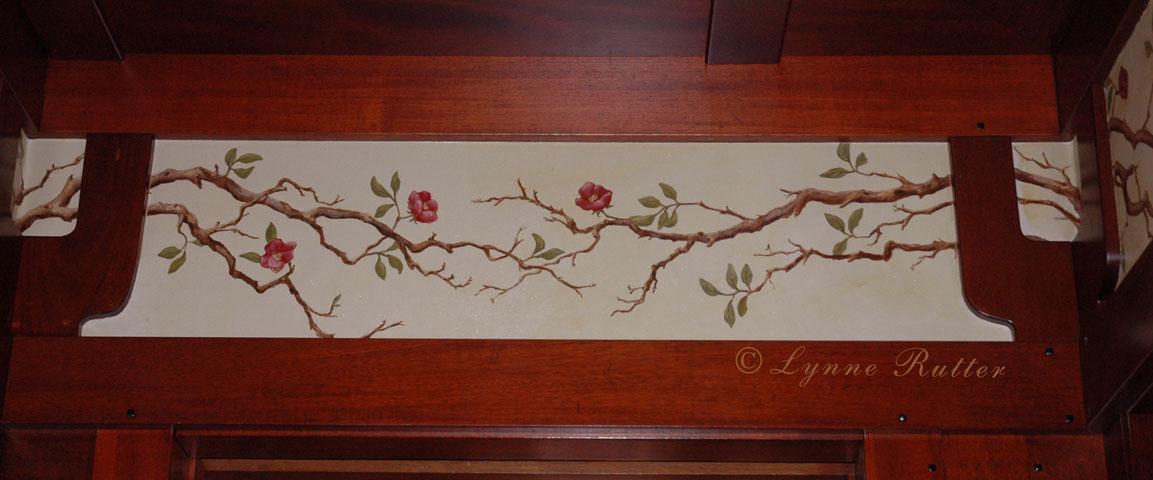
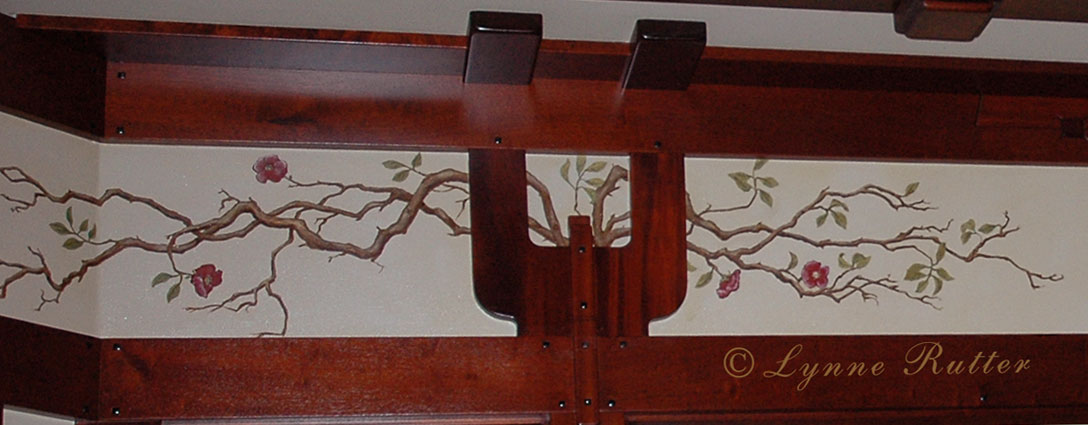
I was commissioned to paint a frieze for the new library, recreated after the famous Thorsen House in Berkeley, California.

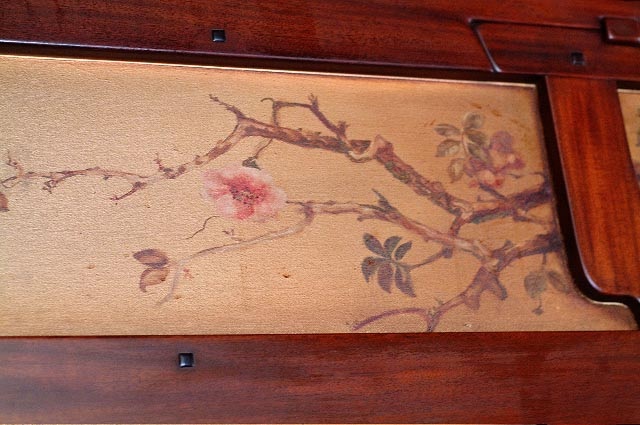
original Thorsen House rose branch frieze, painted by Charles Greene
The rose branches were originally painted by Charles Greene in 1910, on sailcloth, in a somewhat oriental style. These have, over time, discolored from smoke and aging varnish.

Ms. Streisand endeavored to include historically accurate detail in creating this room, and the library has much of the same style of joinery that make up the signature Greene and Greene woodwork. I custom-painted the Thorsen-style frieze using the same style and materials as the original,, and meticulously trimmed the the canvas panels to fit into these mouldings. Some additional painting was done on site to finesse the composition.

The addition of the floral border in the room strikes just the right balance. It's hard to describe, but the effect is stunning.

* While I was allowed to photograph my work, I was asked not to show pictures of this spectacular room itself, as it is to be published in a book the Ms. Streisand is writing.

The Thorsen House is owned and maintained by the fraternity Sigma Phi, whose members take the best possible care of their home and give spontaneous tours whenever asked. They are trying to raise the estimated $10 million needed to restore this landmark.
Please visit their website and make a donation!
frieze is in the glossary!

Monday

Art Deco Chinoiserie


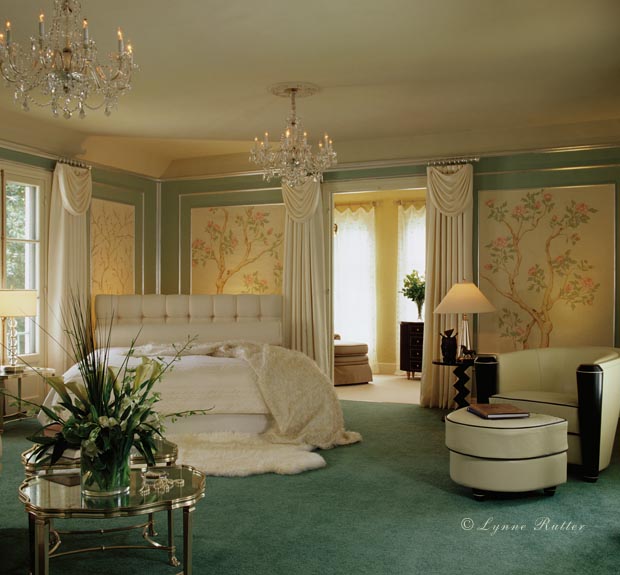
What a gorgeous, romantic bedroom, recalling silver screen Hollywood glamour, bias cut silk lingerie, martinis and cigarette holders....
Interior Designer Paula McChesney, designed this Hollywood Regency master bedroom for the 2003 Coyote Point Decorators Showcase in an historic Hillsborough mansion.
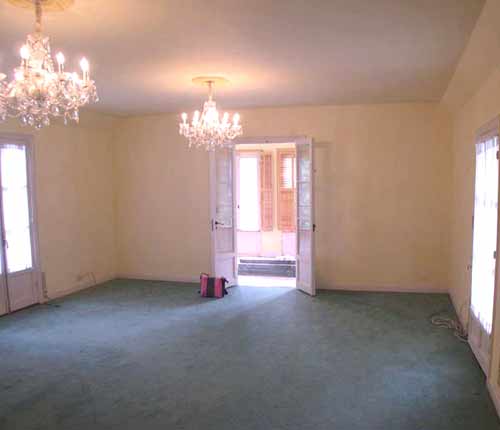
An expert colorist, Paula was understandably concerned about the astroturf green carpet, which we had to keep. The rest of the room- well, it had some problems:
Before: a long rectangular room with green carpet, white walls and a low ceiling beveled on two sides, dueling chandeliers, and not-quite symmetrically placed anything.

The solution: don't fight with the carpet- go green! The walls were painted with Benjamin Moore "Harrisburg Green" HC-132. The ceiling was painted a custom mixed green-grey and the rest of the palette was kept limited.

We paneled the room with three levels of silver moulding, including each corner, and a picture rail which settled the question 'where does the ceiling start?' The moulding was gilt with aluminum leaf in advance at my studio.
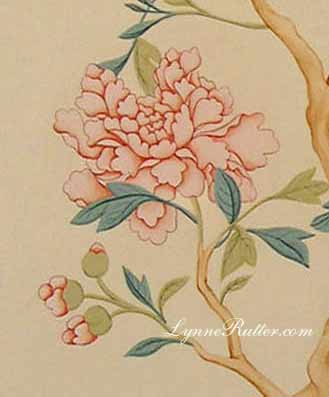
chinoiserie mural detail
For the insets of the panels I painted Chinoiserie murals, using restrained doses of brilliant color. The panels focus attention into the center of each wall, creating the illusion of symmetry, and balancing the architecture. And it was also just darn pretty.

Paula furnished the room all in ivory, like a splendid Jen Harlow gown.

After the showcase ended, the paneling and the murals were installed in one of our client's homes.

I've been collaborating with Paula for over 12 years now. I think this was one of our most challenging and successful rooms.

room photo by David Duncan Livingston


Chinoiserie in Red

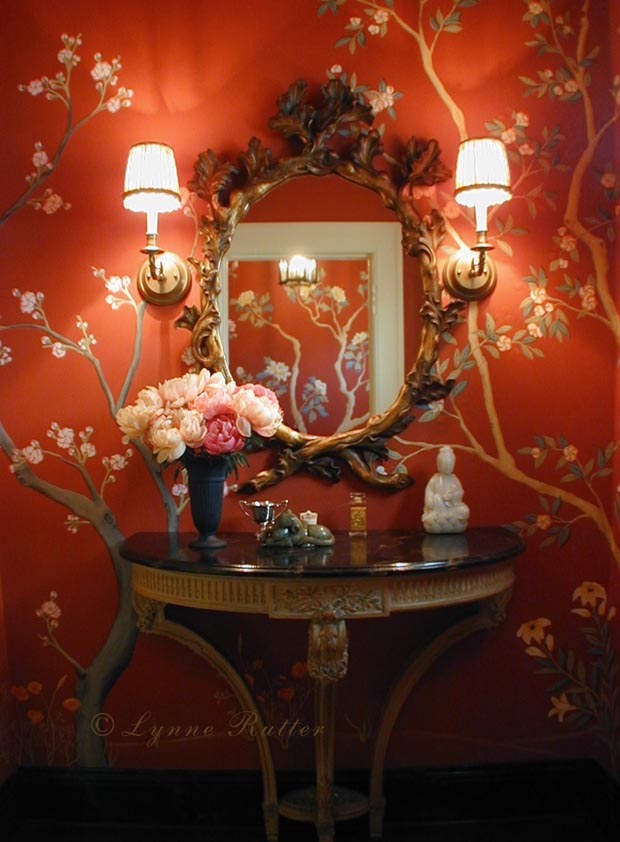
The Chinoiserie Powder Room I designed for the San Francisco Decorator Showcase House - David Papas Photography

Here's one of my favorite historic decorating trends: Chinoiserie.
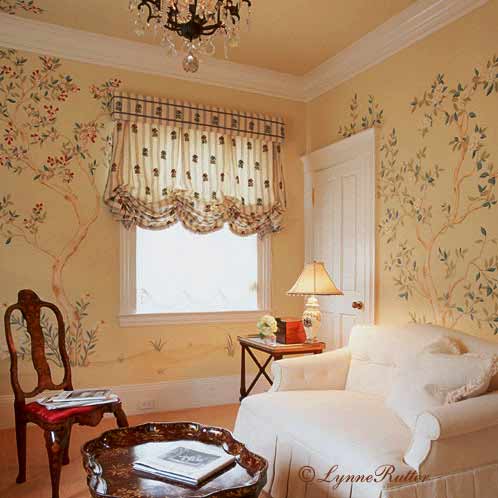
For a number of years now I've been known for painting a certain style of flowering trees Chinoiserie mural using my own spin on the look that was all the rage in late 17th and 18th century French décor.
I adore the wallcoverings of deGournay and Gracie, which are still being produced today in much the same way as the hand-painted wallpapers found in the Royal Pavillion at Brighton, or Lustschloss Hellbrunn, Salzburg. These papers are lush, labor intensive, delicate, and worth every dime they cost.

For this room mural, rather than paint densely covered wallpaper-style panels, I used a light hand, and a more naturalistic approach, to keep this intimate-scaled space airy and uncluttered. Carnelian Red walls help make the room look larger as well as rich and fabulous. And we included California natives such as poppies and monarch butterflies, alongside the lilies, pomegranates, and peonies.

some mentions for this room:
Kafka blog
sfgate


Wednesday

Chinoiserie in Progress


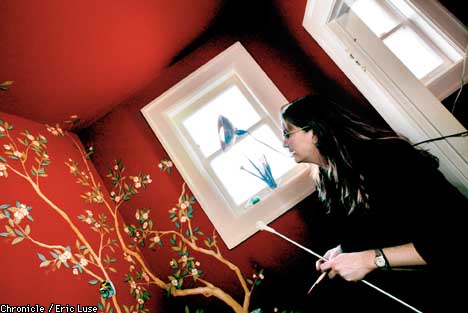
The Chinoiserie powder room, which I designed for the 25th Anniversary of the San Francisco Decorator Showcase, featured in the San Francisco Chronicle
"Show time: Hopes, dreams... "
by Angelica Pence


Hot Stuff


December 2000
San Francisco Chronicle "Hot Stuff" column
"Artist Creates Dramatic Interior Scenes" by Beth Bourland featured a chinoiserie room mural we painted for a client in Pacific Heights.

photo by David Duncan Livingston'