Saturday

Overlooked Ornament in the Salette Borgia

detail of Pinturiccio's  ceiling in the Borgia Apartments, Vatican
Visitors to the Vatican Museums have enough to take in without looking at all the painted borders and ornament that encrust nearly every square foot of the place. However, on my last visit, that is precisely what I was doing!

---- in the Salette Borgia: splendidly painted in jewel tones, and blissfully empty of visitors.


After bidding my companions not to wait for me, and after further hours of careful ceiling-gazing, I was still stopped in my tracks by two small chambers of the Salette Borgia, whose early Renaissance ornamentation is noticeably different in style than the majority of the palace. Ironically these rooms are the entrance to what is now the Collection of Modern Religious Art, which many visitors nearly run through on their way to the Sistine Chapel.

These and other parts of the Borgia Apartments were decorated with wonderful frescoes and ornament including some stylish grottesche, and fresco murals, painted in 1493, by renown artist Pinturicchio and his sizable atelier of assistants. 
These are some of the earliest grottesca paintings done in the Vatican.

painted drapery with the Papal coat of arms of Alexander VI
This entire suite of rooms in the Apostolic Palace was abandoned in 1503, after the death of Pope Alexander VI, because of their association with the disgraced Borgia family. Shuttered and largely disused for nearly two centuries, they escaped  redecoration by later popes.
worn tile floors: evidence of hundreds of thousands of visitors passing through.
A wall paneled with stenciled patterns, and a trompe l'oeil window.
Above it, a fresco by Pinturicchio depicting the Annunciation.
Another detail of the ceiling- note the jewel tone color scheme


In 1891 the rooms and the artwork in them were restored under Pope Leo XIII and opened to the public. Now they seem to be treated as a mere passageway between the more famous parts of the museum... except by those of us who stop to look up.


Click on any image to view much larger


photos in this post by Lynne Rutter, Vatican City, 2008


Monday

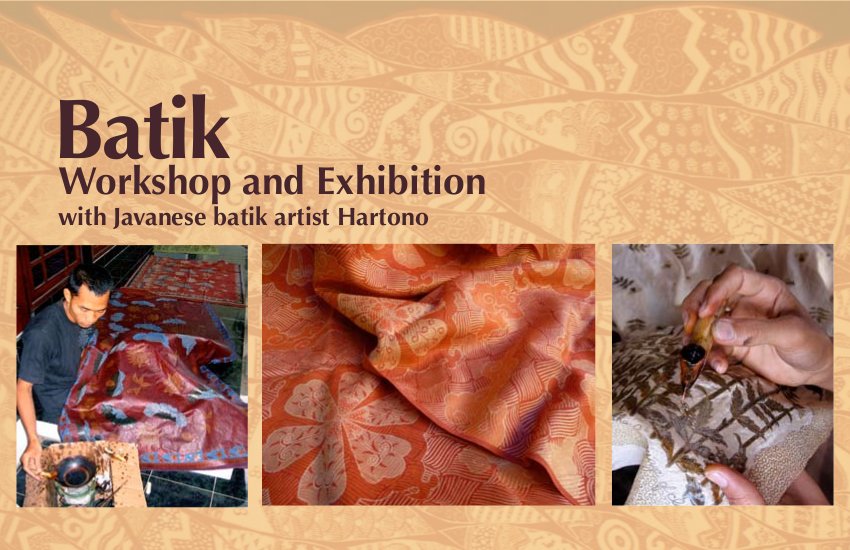
Hartono! Batik Workshop and Exhibition

The Language of Cloth and Lynne Rutter Studio are thrilled to be hosting Javanese batik artist Hartono, visiting the U.S. for the first time, for a workshop on traditional Javanese batik technique, as well as a trunk show and sale of one-of-a-kind batik textiles.

Hartono is a talented young artist of the newest generation of batik-makers from Solo, Central Java, a center for batik-making for over 150 years. Hartono’s designs incorporate Japanese and European motifs which he blends with traditional Javanese patterns.

Saturday, October 24 from 9am - 5pm
Hands-on batik workshop
* 6 to 8 pm Reception for the Artist

Sunday October 25th from 10am to 6pm
Exhibition and Trunk Sale with batik demonstrations

at Lynne Rutter Studio
2325 3rd St. #207, San Francisco, CA

The Saturday workshop will be an intensive one-day hands-on introduction to the basic techniques of Javanese batik making. Participants will complete their own batik creation on silk, with instruction from Hartono from start to finish.
The class is limited to 8 participants and the fee including all materials is $100.

Contact Daniel at The Language of Cloth to reserve your place: daniel@thelanguageofcloth.com
or call 415-613-9693


Friday

The Steampunk Aquarium Mural

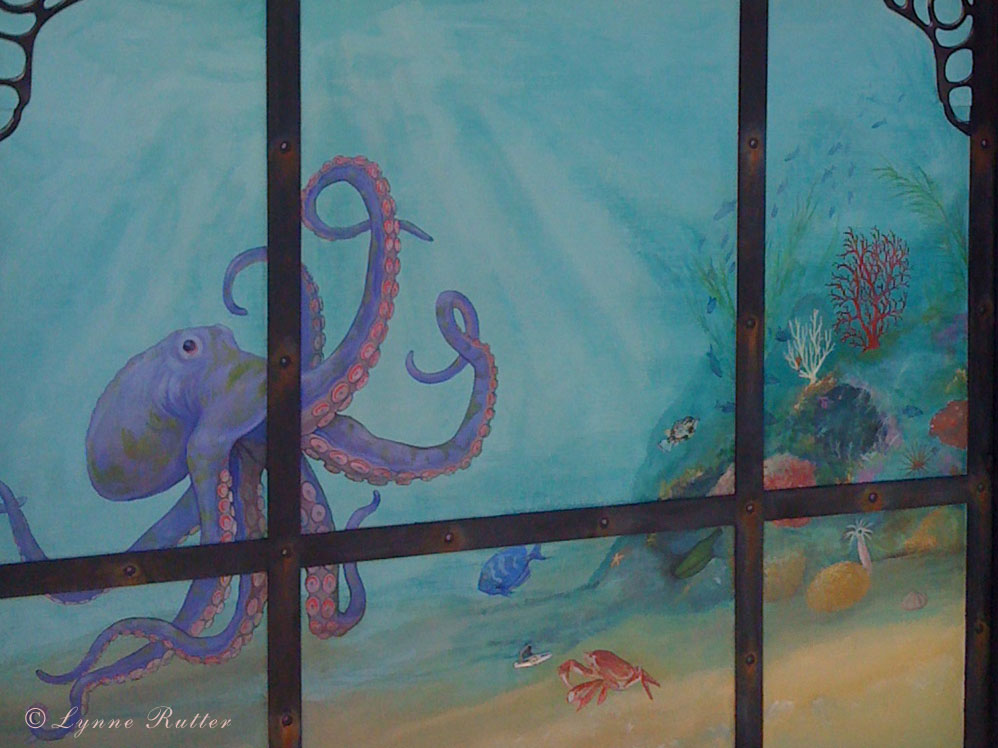
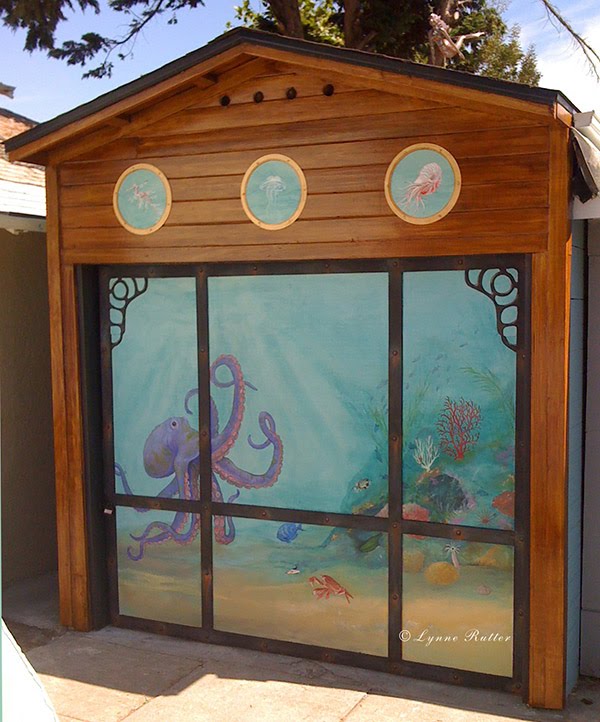
Giant octopus in a rusting iron aquarium
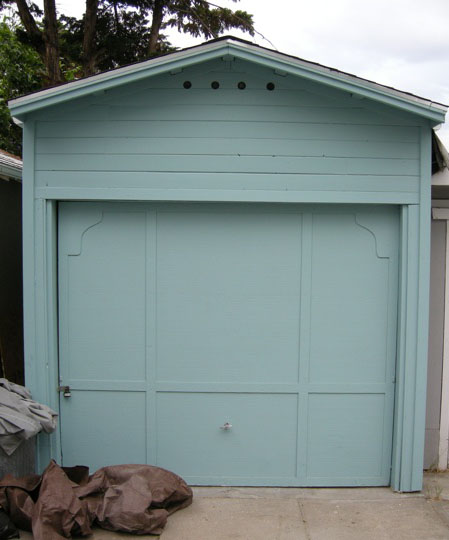
the garage before painting
I recently completed a fabulous project on a tiny detached garage in Oakland, California. My client is an avid scuba diver who loves all things Victoriana, and has a special attraction for octopi. So I devised a plan for a Jules Verne-inspired aquarium.

I designed the mural to incorporate the entire structure: the garage door became the glass "tank" and the building its "case."


The finished mural with many surprising details
In retro- steampunk fashion, trompe l'oeil rusting iron bolts and cast-iron brackets hold the aquarium tank together in a Victorian-style oak woodgrained case. The mural is completed with three portholes at the top and protected with several coats of UV varnish.


all images in this post ©Lynne Rutter

click on images to view larger


Sunday

Restoring a tapestry mural

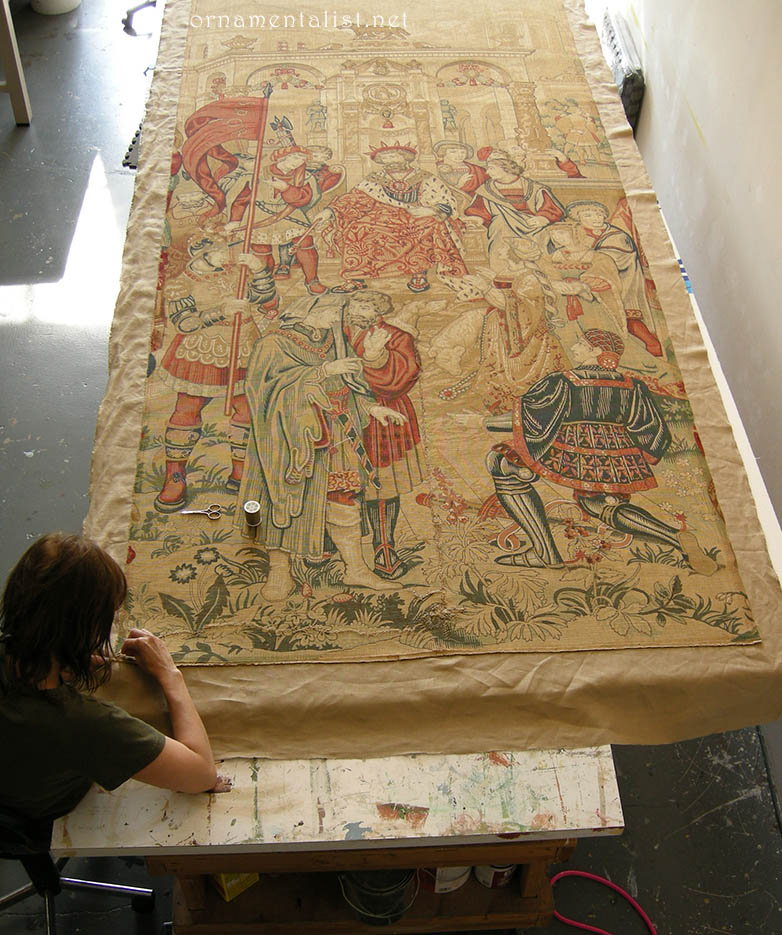
My studio recently completed the restoration of an antique tapestry mural.
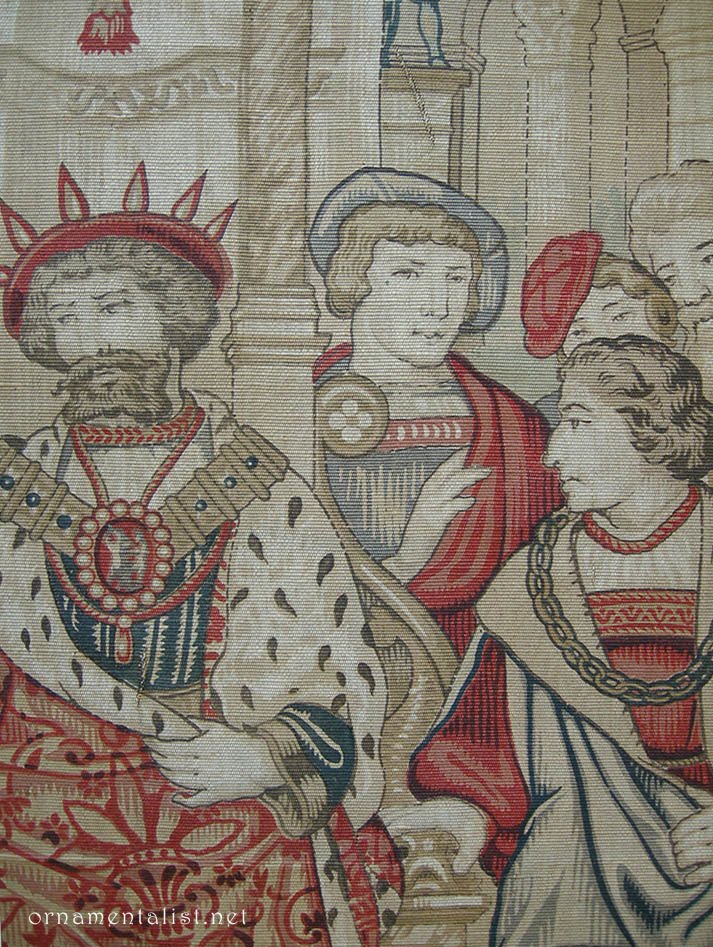
This is one of a pair of very nice ten foot tall panels that have hung in the lobby of a Spanish Revival apartment building in Pacific Heights since it was built in 1910. The murals are based on a 17th century Gobelins tapestry designs, and are printed on linen using the newfangled technique of silkscreen printing (invented in 1907) combined with the far more traditional printing technique of stenciling.

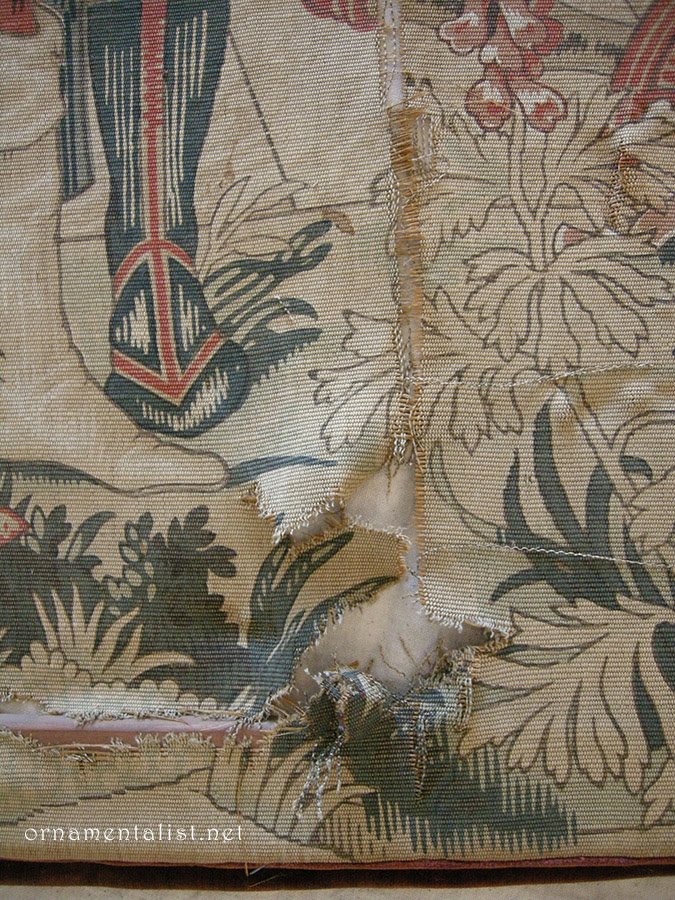
a major rip at the base of the mural

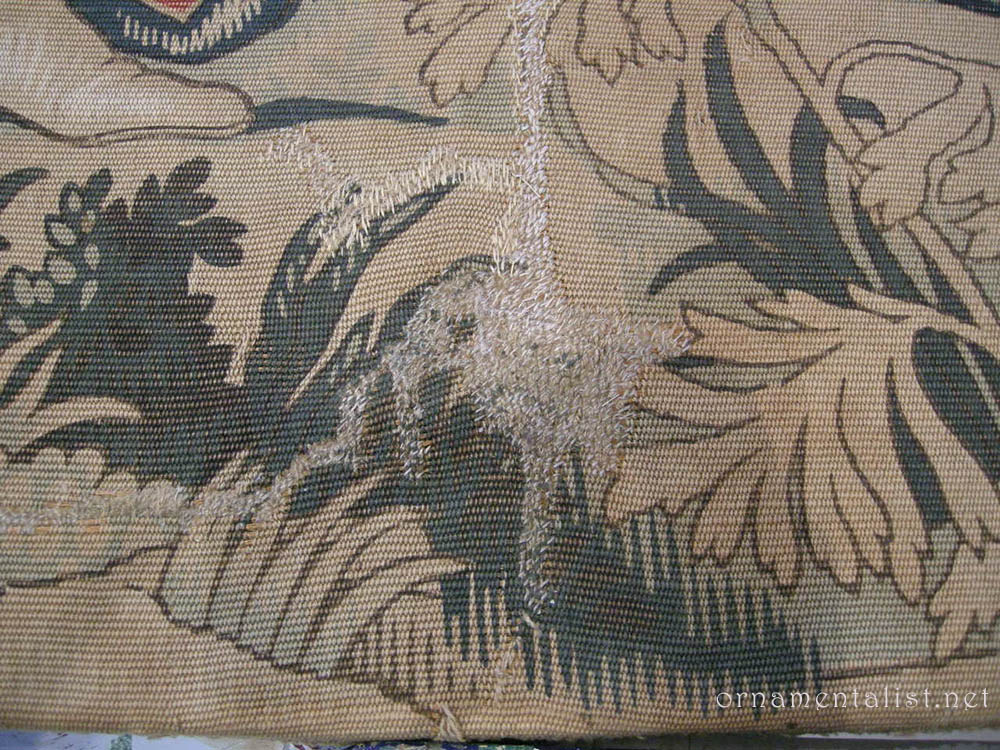
One of the panels suffered some major damage: a large rip at the base, followed by a six foot long tear straight up the center. Some areas of the material were missing, and the surface was laden with nearly 100 years of accumulated dust, smoke, and dirt.
To restore this mural, we needed to clean and stabilize the entire piece, repair the damage, and recreate the lost areas.
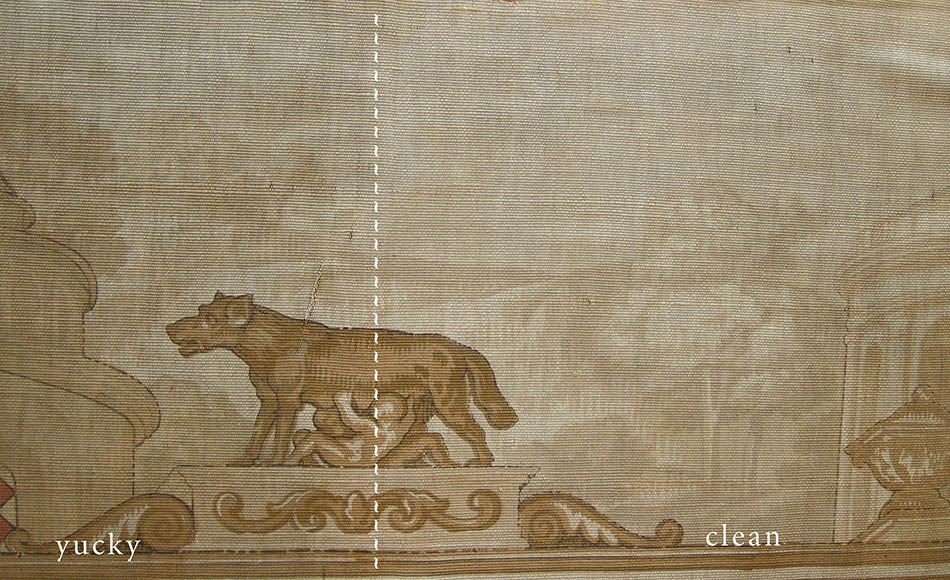
We started by removing it from its frame, and giving it a gentle cleaning front and back.

During cleaning, much of the more subtle detail emerged.

To stabilize the mural, we lightly stitched the major rips closed, then backed the entire piece with a new piece of linen. The perimeter of the panel was then sewn by hand onto the backing for added strength.

My associate Angela is a skilled conservation technician who has worked for many years restoring art for museums and collectors. We met during a large restoration project in 1993 and she has assisted me on numerous jobs since then.
Angela securing the mural to its new backing

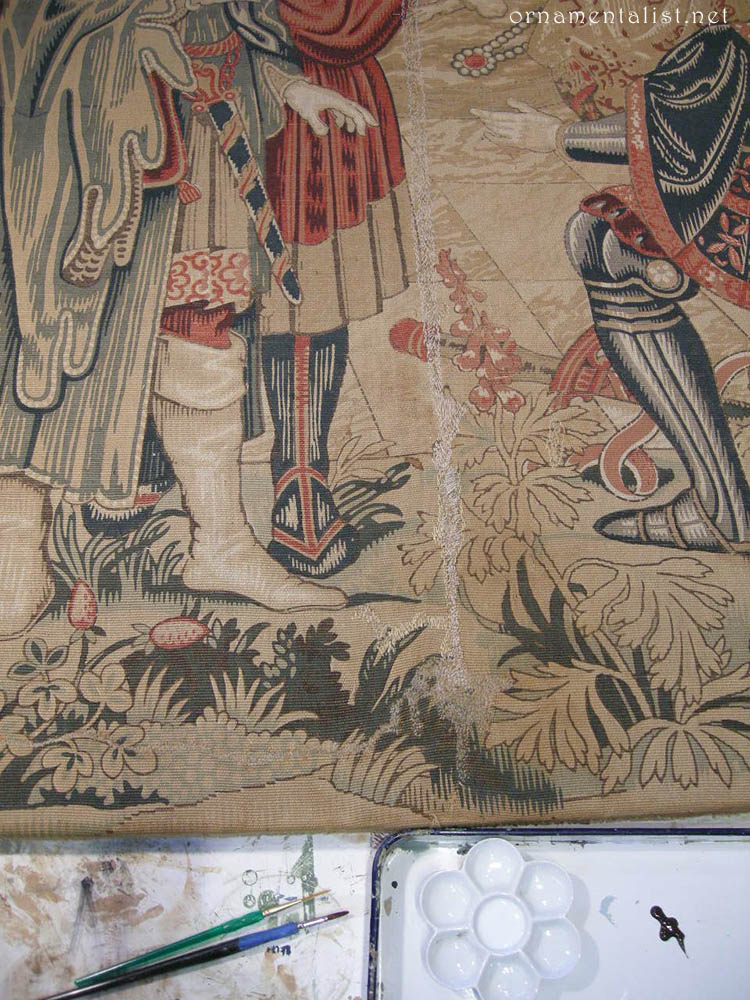
Tears, rips and areas of fabric fatigue were painstakingly stitched to the backing, to prevent the rips from spreading, and to fill in for missing material.

Thousands of tiny stitches fill in the ripped area.

Once the sewing was finished we re-stretched the mural back onto its stretcher bars, which we had also reinforced.


I mixed up eleven different colors of paint to match the tapestry's palette, which I then lightly daubed over the stitches to help them blend in to the surrounding areas.

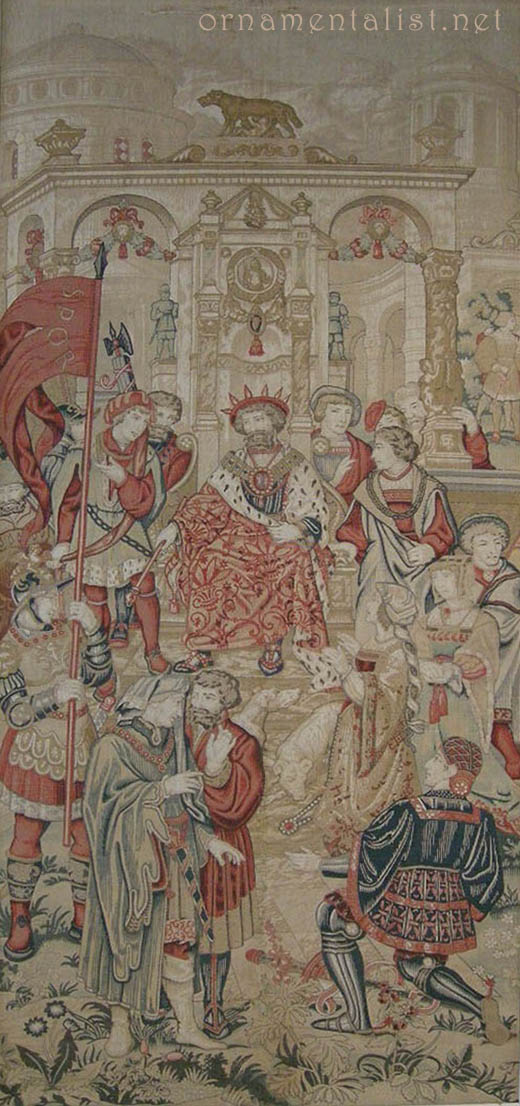
In some places the image was missing and had to be recreated. While not entirely flawless, the tapestry looks wonderful and its repaired sections are hardly noticeable.


The restored tapestry (left)


Click on any image to view larger


Lynne Rutter Murals and Decorative Painting

Friday

Exterior Color: Noe Valley Victorian


Beautiful Victorian details celebrated with six colors and gold leaf!

Before:  Pink and Cute!
This Victorian in San Francisco's Noe Valley could not help being a bit cute. The Stick-Eastlake Cottage had been painted about 15 years ago using the pink colors from the magnificent hortensia blooming in its front entry.

When it came time to repaint, the owners asked me to design something a bit more grown-up.


Choosing a Color: I ask my clients to drive around town and photograph houses of similar style whose paint schemes appealed to them. Every one they chose was green! So we started with green. The color scheme I devised for this house uses six colors, all from from Benjamin Moore's Historic Color range, with 23 karat gold leaf on the buttons and pediment ornaments.


Managing contrast: This palette is as much about contrast as it is about color. One technique being employed here is the use of what I call a "secondary trim" color, which in this case is about 30% darker in value than the main trim color, and is used to support features like brackets and window columns, and to create a break between the main body color of the house and the more vibrant accent colors of the window sashes and insets.

after- green, gold, and ivory
Know when to say when: The custom garage door was simplified from three colors to one, and painted the same as the body color, so as not to compete for attention from the main part of the facade. The front door, which had been whimsically painted with four different colors, now sports a more European look in a solid glossy teal with polished hardware and gold leaf details, leading the eye right to the entrance.

After: the Victorian cottage as stately home

click on any image to view larger


Expert Painting by San Francisco Local Color Painting
paint:  Benjamin Moore Historic Colors

Color Consulting by Lynne Rutter 415-282-8820


Update!
This project has been featured in the June 2015 issue of Old House Journal.  After nearly  8 years, this is still one of my most talked about color designs.
At this time I can say that the basic colors for this scheme are Louisberg Green and Standish White by Benjamin Moore.  You will notice in the OHJ article several other uses of Louisberg Green and see how very different that color can look depending on the environment, orientation and accent colors.