Saturday

Everything Is Going To Be OK

Sun streams into the clerestory windows of the Badìa Fiorentina
This  week I was somewhat lost in a haze as a family emergency had me nearly packed and on a plane.  I walked around Florence clutching my phone waiting for word on my father's condition, unable to do much else, all other plans on hold.  The best possible  news arrived late yesterday evening and I felt like lighting candles and so wandered into the church nearest me, so dark and austere and dramatically lit. I found some candles and offered the rest of my change.
The next morning I returned to the same church, which happens to be the ancient Badìa Fiorentina, to show it to Erling,  when the sun broke through the clouds and streamed into the clerestory windows, illuminating a beautiful carved wooden ceiling which had been all but invisible moments earlier.  All I could think of at that moment was "thank you."

** So anyway, the carved wooden ceiling, which conceals the original Gothic trusses, was created by Felice Gamberai in 1631 as part of a Baroque remodel.


photo by Lynne Rutter February 2014

Monday

Sala Verde

Sala Verde - Ceiling Decorations by Ridolfo del Ghirlandaio 1540-42

This room I find most inspiring.  The Sala Verde, or Green Room, in the Palazzo Vecchio, takes its name from the landscape murals which previously covered its walls. The room was decorated as part of the private apartments of Elenora of Toledo, and was meant to be like a garden room or a trompe l'oeil loggia.
The wall murals long lost, a simple wash of green on the walls creates a shady atmosphere. I adore this color and I adore the way the ceilings look somehow more contemporary in this more simplified setting.
parrots and other exotic creatures populate the grottesca ceilings by Ghirlandaio
The ceiling grottesca paintings are filled with parrots and other birds (I seem to be noticing parrots wherever I go, perhaps because I am missing my beloved so much.)


photos by Lynne Rutter, Florence, February 2014
click on images to view larger


Firenze com'era

Fiorenza, detail, by Stefano Bonsignori
I was a bit sad to learn that  one of my favorite quirky little museums, Museo Storico Topografico di Firenze com'era has been closed. This was one of those city museums with models and old maps and artifacts pertaining to the history of the city and the lives of its past citizens.  Although small and a bit dark, it was nevertheless a charming and informative place.  

the Della Catena Map of Florence, 1490 courtesy Brown University
 

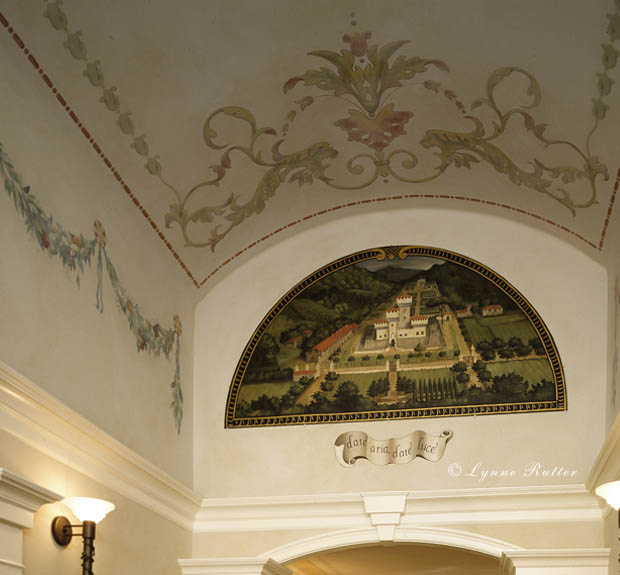
Notable in the collection was a series of lunette murals of Medici villas, painted by Giusto Utens around 1599.  One of which, Cafaggiolo, was the source of a mural I painted some years ago.
Lunette mural after Giusto Utens, by Lynne Rutter

Fragments of the old com'era collection are being displayed in a room of the Palazzo Vecchio, including a huge painting by cartographer Stefano Bonsignori of Fiorenza in the 1490s as well as a superb reprint of the Pianta della Catena attributed to Lorenzo Rosselli, and a series of beautiful 19th century oil sketches painted by Augusto Marrani in the late 19th century, depicting the narrow streets and picturesque passageways of the old Florence Ghetto, just before it was all torn down in a "much-disputed urban redevelopment progamme."
Strapwork cartouche detail of a map of "Trogloditica" painted by cartographer Stefano Bonsignori, Guardaroba, Palazzo Vecchio.
Fiorenza, detail, by Stefano Bonsignori

Maps are to me really fascinating, not just as historical documents but as examples of the artful and inventive display of information, and often great graphic design.   Fortunately for us map geeks, the Palazzo Vecchio also has an entire room dedicated to maps, designed by Vasari for Cosimo I de' Medici.  


click on images to view larger 
unless otherwise noted, photos by Lynne Rutter, Florence, Italy February 2014


Friday

Studio Visit: FlorenceArt.net Studio d'Arte

detail of gilt and painted ornament on a harpsichord, by Alison Woolley

My good friend and collaborator Alison Woolley has a lovely studio here in Florence, and my first order of business after settling in to our apartment was to visit FlorenceArt.net Studio d’Arte and get a look at the harpsichord she just finished ornamenting, a prestigious commission for the L'Opéra Royal de Versailles.
Harpsichord built by Atelier Marc Ducornet and painted by Alison Woolley
The "Ruckers Taskin" style harpsichord was built by Atelier Marc Ducornet in Paris, and shipped to Florence for Alison to decorate.   The design of the piece was inspired by the architecture and ornament in the Château de Versailles.  

detail of interior of harpsichord lid, gilt and painted by Alison Woolley
Yesterday Erling and I went to the studio to help pack the finished harpsichord and then the shipper came and took it away to Paris and we all felt a bit sad to see it go, particularly Alison who had been working on this for months. I know I feel a bit blue when I send off a mural from my studio and all of a sudden it seems terribly blank and quiet.
Fortunately another harpsichord will be arriving in Alison's studio soon.
samples of work at FlorenceArt.net
Elsewhere in the studio are examples of  designs, class projects, experiments,  Florentine style painted furniture, and a beautiful (top secret) design for a scarf for Salvatore Ferragamo. 
gilding tools at FlorenceArt.net


Alison regularly teaches classes in the tradtional Florentine techniques of gilding and painting furniture and other fine surfaces at the FlorenceArt.net studio as well as through special retreats in Italy and intensive workshops.  The studio accepts commissions year-round for furniture, instruments, murals, and seriously beautiful things.


Watch this video of another recent project by Alison Woolley: painting a Claviorganum.


The light in Florence is the color of Joy

The view from my Florentine home:  watching the light change over the surface of the Duomo.
Florence in the winter is lovely, empty of tourists, and our apartment has a spectacular view of the Duomo and Campanile.    I have visited here so many times in the past (cough) 34 years, but those visits were all so brief.  It’s so nice to just sit here and appreciate the light.  We awake every morning to ringing bells and a view of the Duomo.  In the evenings Brunelleschi's masterpiece is bathed in that special Florentine light, which at times infuses everything with my favorite color of yellow.

I wander the streets getting a bit lost and finding inspiration in every doorway.  I recognize the culture here as my own even though I grew up a world away, and feel the importance of art and beauty in daily life here, without the plastic layer of that weird modern need to justify the cost of everything.